

I carried the original Atmotube Pro for over three years, right up until its battery finally gave out, and it’s been the portable monitor I’ve recommended to most people for almost as long. So when the Atmotube Pro 2 arrived, the obvious question for me was the same one many owners will be asking, and it’s the one this Atmotube Pro vs Atmotube Pro 2 comparison sets out to answer. Is it worth upgrading, and if you’re buying for the first time, which one should you choose?
Put simply, the Pro 2 is the better buy for most people because it adds a CO₂ sensor, which lets one device do the job of two. If you already own an Atmotube Pro and only care about particles, though, there's little reason to upgrade, since both use the same particle sensor.
For years, I carried two devices most days, an Atmotube Pro or AirBeam 3 for particles and an Aranet4 Home or AirSpot for carbon dioxide (one mostly for outdoors, one for indoors). The Pro 2 is the first portable monitor that promised to replace both, which is a big part of why I was so curious about it. I’ve since carried it every day for several weeks, clipped to my backpack or sling bag, and occasionally to my wife’s handbag.
My full Atmotube Pro review and Atmotube Pro 2 review cover each device in much more depth, and if you’re weighing up a different portable monitor altogether, my older Flow 2 vs Atmotube Pro comparison is also worth a read. Here, I’ll focus on what changed between the two generations, what stayed the same, and who each one suits.

I independently review air quality monitors with a focus on accuracy. I’ve tested well over 50 devices, compared some of them against reference instruments, and rely on peer-reviewed research and third-party studies wherever possible.
I don’t accept sponsored posts or paid reviews, and I don’t run ads on BreatheSafeAir. When I receive a free product, the company has no say in what I write. Affiliate links don’t influence my views and never increase the price you pay.
I’m constantly learning about how these sensors work – from opening them up, discussing with researchers in the field and examining the hardware inside. That ongoing learning process helps me write reviews that are grounded in how the technology actually behaves, not just what the spec sheet says.
You can read my full Disclaimers & Ethics page for complete details. And as with any review, even mine, I always encourage checking multiple independent sources before making a decision.
This post contains affiliate links. For more information, please refer to my affiliate disclaimer. I was sent a product for review, but the article is not sponsored. All opinions expressed in this post are my honest thoughts. I only recommend products that I genuinely believe in.
Informational Purposes: Information on this blog is for informational purposes only. Readers are encouraged to confirm the information herein with other sources. This website assumes no responsibility for the accuracy of the information, and information is subject to change without notice. Products mentioned on this website are not medical devices and do not guarantee protection.
If you notice any errors or inconsistencies in this article, please contact me so I can update the information accordingly.
Contents
What Changed (and What Didn’t)

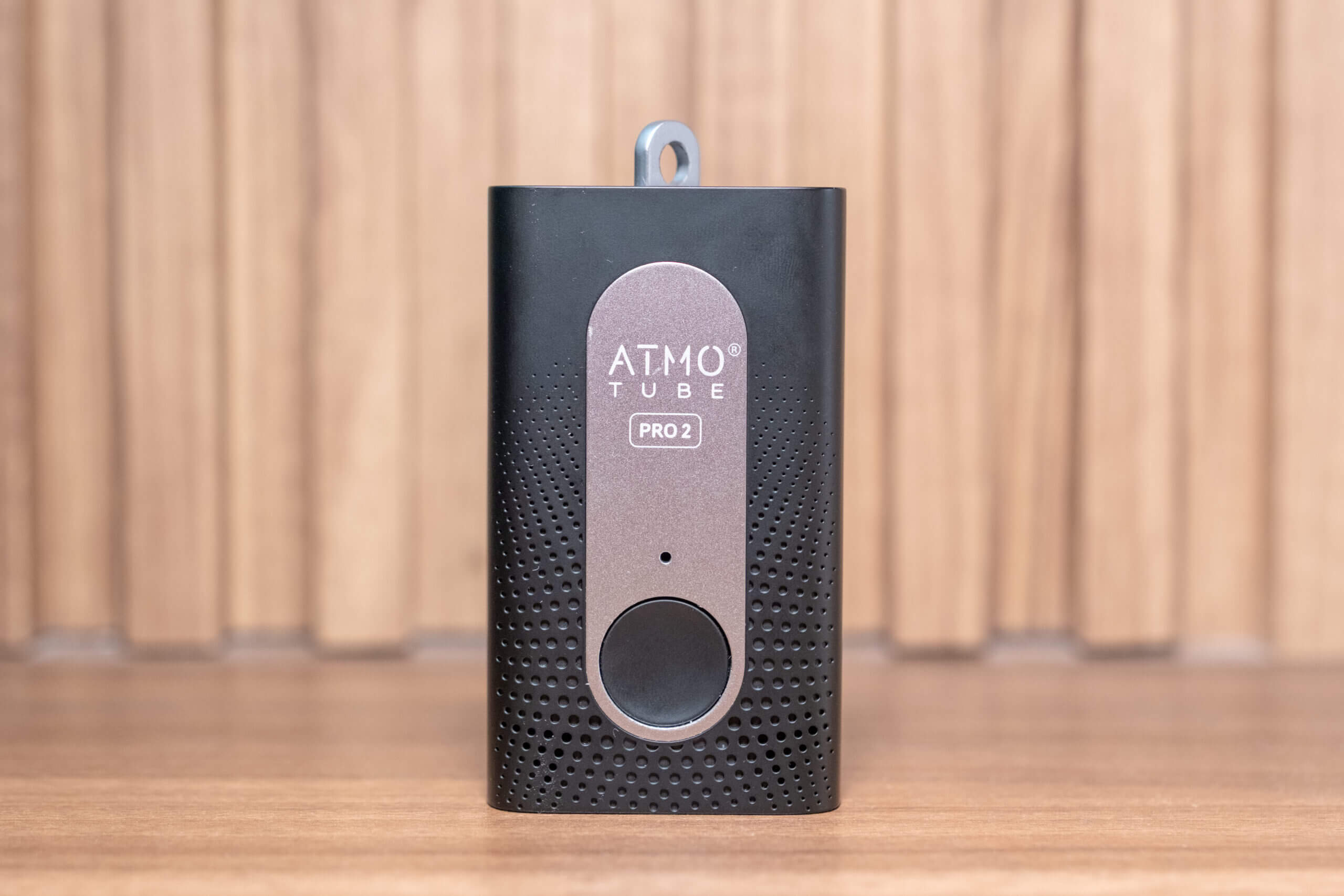
From the outside, very little changed. If you covered the label, I couldn’t tell you which generation I was holding. Inside, however, the Pro 2 adds a carbon dioxide sensor, a newer VOC sensor that also reports NOx, a built-in GPS chip and far more internal storage. Below, I’ve put together a table comparing the two.
| Atmotube Pro | Atmotube Pro 2 | |
|---|---|---|
| Particle sensor | Sensirion SPS30 | Sensirion SPS30 (unchanged) |
| Carbon dioxide | None | Sensirion STCC4 (thermal conductivity, ±100 ppm ±10%) |
| VOC sensor | Sensirion SGPC3 (relative index) | Sensirion SGP41 (VOC and NOx index) |
| Temperature, humidity, pressure | Yes | Yes (updated sensors) |
| GPS | Via your phone only | Built in, or via your phone |
| Internal storage | Up to 10 days | Up to 45 days |
| Particle reading interval | Every 10 minutes in my use | Every second to every 15 minutes |
| Battery in my use (10-minute readings) | 8-9 days | About 8 days (GPS off), about 3 days (GPS on) |
| Mounting loop | Plastic loop with metal carabiner | Rotating metal loop with carabiner |
| Size and weight | Externally identical | 86 x 50 x 22 mm, just under 100 g |
| App | Atmotube | Atmo PRO2 |
| Price | Around $189 | From $250 |
The one thing Atmo deliberately left alone is the particle sensor. Both devices use the Sensirion SPS30, which is a big part of why the original earned its reputation, and it means anything I said about the original’s particle accuracy still applies to the Pro 2.
BreatheSafeAir is a one-person publication. Every share and every subscriber is important to me.
I don’t have a marketing budget or a team behind me. Just a lot of test equipment and a genuine interest in helping you make sense of your air quality. If you find this useful, subscribing to my newsletter is the best free way to support the work. You’ll get information on what I’m currently testing, findings that don’t make it into the full reviews, and the kind of detail you only get from someone who thoroughly tests these devices.
Accuracy

Since the particle sensor is identical, so is particle accuracy. In AQMD’s field testing, the Atmotube showed strong agreement with reference instruments for PM1 and PM2.5 (an R² of around 0.8 to 0.9), and the SPS30 is the only sensor to have achieved MCERTS certification, with a measurement uncertainty below 10% between 0 and 75 µg/m³. PM10 is the weak spot on both, but that’s true of nearly every low-cost optical sensor, so I’d pay attention to PM1 and PM2.5 with either device.
Carbon dioxide is where the Pro 2 moves into new territory. It uses Sensirion’s tiny STCC4, a thermal conductivity sensor that is specified at ±100 ppm ±10%, which is noticeably looser than the NDIR sensors in most dedicated CO₂ monitors. When I sealed it in an airtight container alongside a factory-calibrated Aranet4 Home and changed the temperature, the two tracked each other far more closely than I expected. On my commutes, the Pro 2 also updated almost in real time, while my Aranet4 felt slow to react even at one reading a minute.
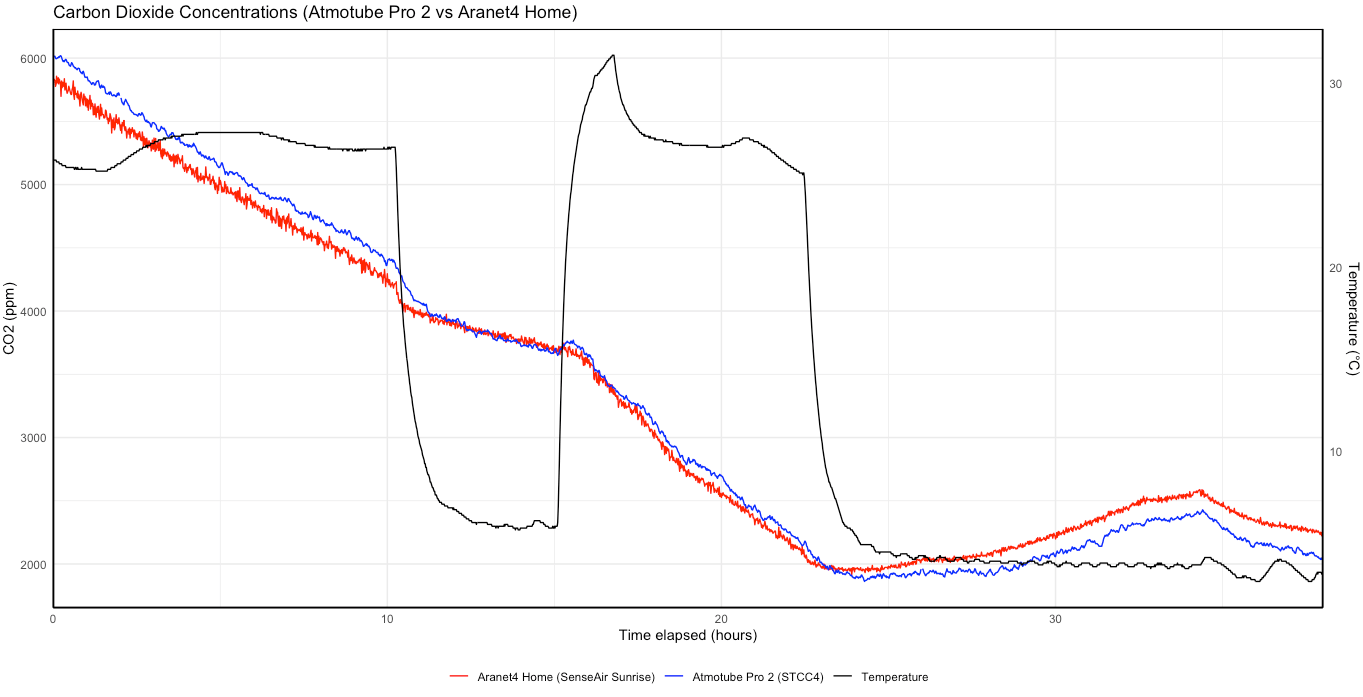
However, there’s an important caveat that the original never had to deal with. Partway through my testing, the Pro 2’s CO₂ readings started running consistently higher than the Aranet4. It still followed the trends well, which points to its automatic calibration rather than a faulty sensor, but I’ve heard the same from other owners, and the manual calibration option wasn’t working at the time. I also saw issues when the device sat in the sun and its internal temperature passed 40°C.
The VOC side is a sidegrade more than an upgrade. The original’s SGPC3 and the Pro 2’s SGP41 both report a relative index rather than a true concentration, so they’re good for spotting trends and nothing more. The Pro 2 adds NOx readings, but temperature swung those so much in my testing that I wouldn’t trust them.
Battery, Storage & GPS

Battery life is closer than the spec sheets suggest. In my own use, the original Atmotube Pro lasted eight or nine days between charges with a particle reading every 10 minutes (comfortably beating Atmo’s own one-week estimate). The Pro 2’s app estimates 8 days and 5 hours at that same 10-minute interval with the GPS switched off, so for the way I used the original, the newer device lasts about the same, not longer.
Turn the Pro 2’s GPS on and the estimate falls to around 3 days at the same interval, with every GPS-on setting landing somewhere between just over a day and three and a half days. That’s the real trade-off. The original needed your phone nearby to record location, while the Pro 2 can log location on its own, and with 45 days of internal storage against the original’s 10, it can be left to record for weeks between syncs. The catch is that syncing after a few days can take up to a minute, and I’ve occasionally had to force-quit the app before it would connect, which I don’t remember happening as often with the original.
Battery longevity is the other thing I’d keep in mind. My original Atmotube Pro lasted around three years before its battery failed, and while Atmo’s warranty covers the Pro 2 for a year, the embedded battery is only covered for 8 months.
Design & Everyday Carry


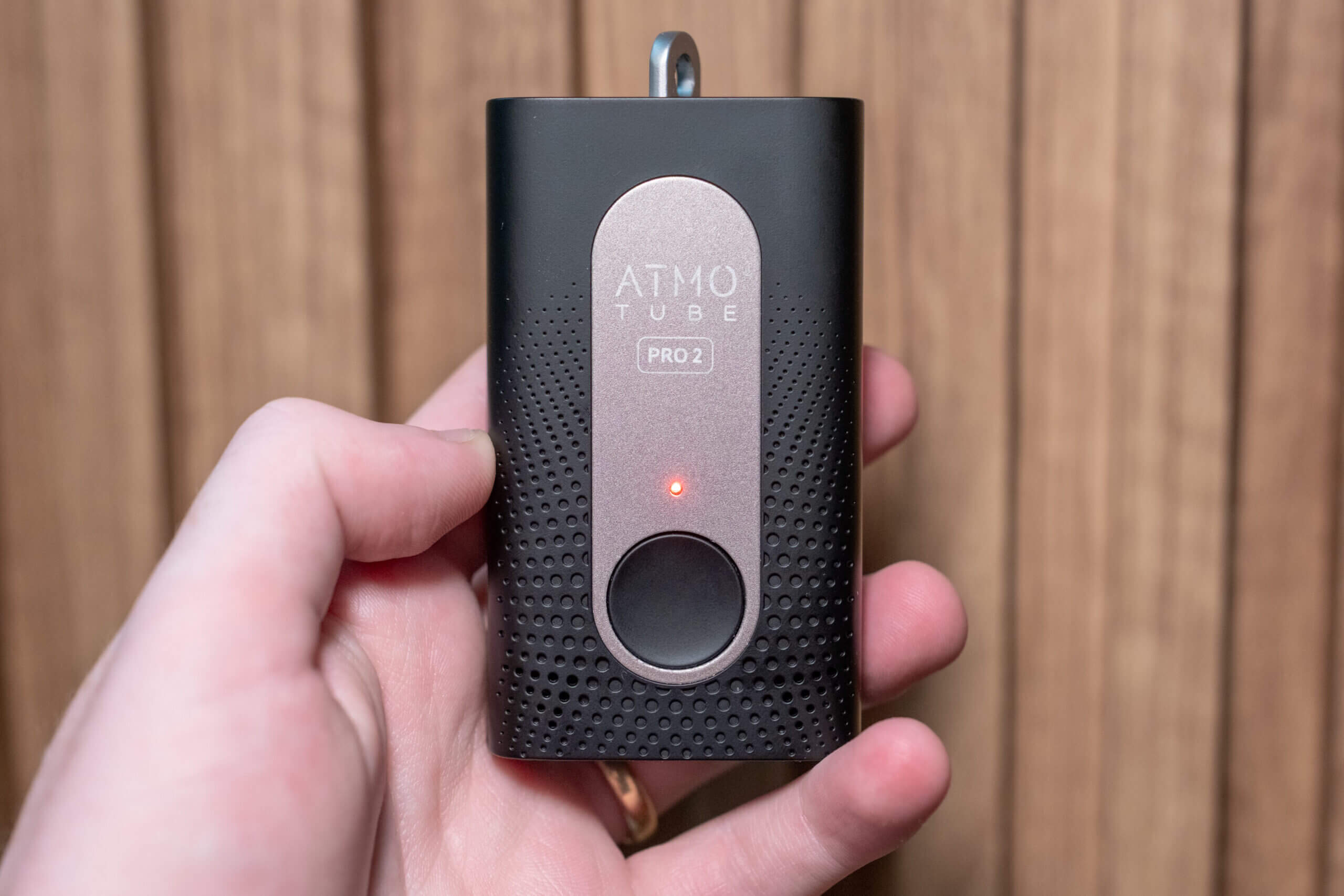
Both devices are the same small, plastic body with vents on the front and a carabiner at the top, and at 86 x 50 x 22 mm and just under 100 grams, the Pro 2 disappears on a backpack. I usually clip it to the zipper pulls on my backpack or sling bag, and when my wife heads out, it often goes with her on her handbag. Since it’s mostly black, it’s also discreet, and I’ve rarely had anyone ask me about it (the AirBeam 3 drew far more questions).
There is one design change that’s easy to miss. In my original review, my biggest build complaint was the plastic loop at the top, where the metal carabiner attaches, and I said I would like to see it replaced with metal for people who ride with it. The Pro 2 now uses a rotating metal loop, which fixes exactly that. Neither device is waterproof, though, so both still need to be tucked away in the rain.
App & Connectivity

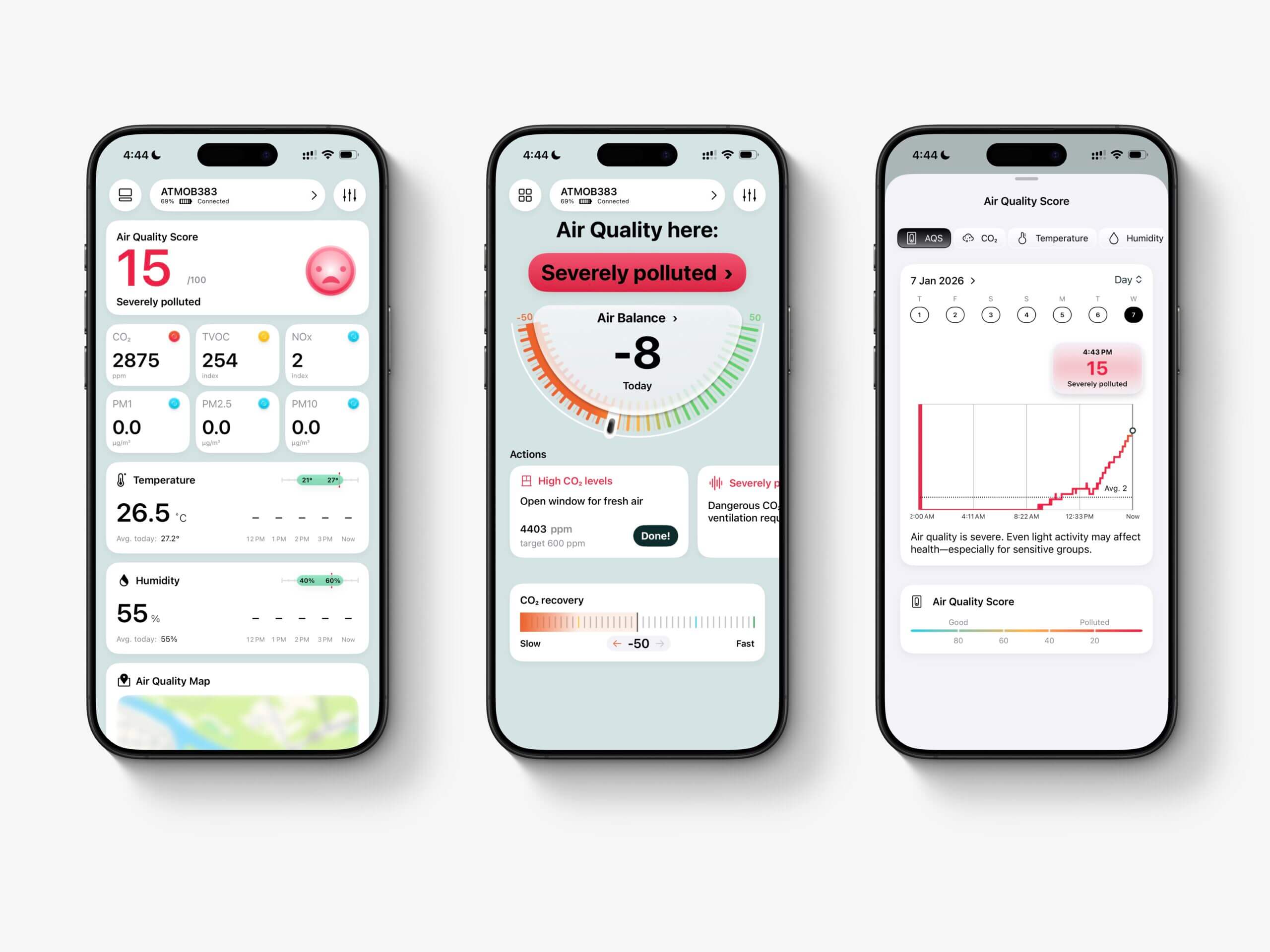
The original Atmotube app was one of the better air quality apps I’d used, and the Pro 2 moves to a new app, Atmo PRO2, that builds on it rather than replacing what worked. Both use Atmo’s 0-100 Air Quality Score, where 100 is the cleanest air, which I still find counterintuitive next to standard AQI scales.
Where the new app pulls ahead is in the enthusiast settings. You can set the particle interval anywhere from every second to every 15 minutes, apply your own temperature and humidity offsets, calibrate the CO₂ sensor, and add notes to locations on your personal map (handy for explaining a spike, like walking past a street vendor’s grill). Both apps export your data as a CSV file, so neither locks your readings away.
Price & Value

The Pro 2 starts at $250, while the original now sells for around $189 (it was $150 when I first reviewed it). That’s $61 more, or about a third extra, for the newer device. Interestingly, the original Atmotube Pro also has the higher overall score of the two on this site (4 against 3.5), even though the Pro 2 is the better device in almost every way. The scores for accuracy are identical, the Pro 2 scores higher on build, and it loses its points on battery and value.
That’s really the whole comparison in one line. The Pro 2 is the more complete monitor, while the original is the better deal if you only care about particles. If you would otherwise pair the original with a separate CO₂ monitor, though, the combined cost quickly approaches the Pro 2’s price, and that changes the maths.
Conclusion – Should You Upgrade to the Atmotube Pro 2?

If you already own a working Atmotube Pro and mainly use it for particles, I wouldn’t rush to upgrade. You’d be paying for the same particle sensor, and the battery life at a 10-minute interval is about the same. On the other hand, if you’re currently carrying a second monitor for CO₂ like I was, the Pro 2 is the upgrade that actually changes your routine, because it lets one device cover your commute and the rooms you end up in.
For new buyers, I’d recommend the Pro 2 to most people, since it’s the more complete device and it fixes my one build complaint about the original. However, if you only want to track particles and can still find the original Atmotube Pro at around $189 while stocks last, it remains a very good monitor and the cheaper way in.
Whichever you choose, keep the Pro 2’s CO₂ calibration caveat in mind, and if you do buy the Pro 2, switch off its internal GPS whenever your phone is with you, since that alone nearly triples the battery life.
Atmotube Pro vs Atmotube Pro 2 FAQ
Is the Atmotube Pro 2 more accurate than the original Atmotube Pro?
For particles, no. Both use the same Sensirion SPS30, so PM1 and PM2.5 accuracy is the same. The Pro 2 adds a CO₂ sensor and a newer VOC sensor that the original doesn’t have.
Does the original Atmotube Pro measure CO₂?
No. Carbon dioxide is new to the Pro 2, which uses a small thermal conductivity sensor that is less precise than the NDIR sensors in dedicated CO₂ monitors.
Which has the better battery life?
They’re closer than you might expect. My original lasted eight or nine days with readings every 10 minutes, while the Pro 2’s app estimates just over 8 days at the same interval with GPS off, and around 3 days with GPS on.
Do the Atmotube Pro and Pro 2 use the same app?
No. The Pro 2 uses a new app called Atmo PRO2, while the original uses the standard Atmotube app.
Is the Atmotube Pro 2 worth the extra money?
It is if you want to track both particles and CO₂ with one device. If you only care about particles, the original Atmotube Pro gives you the same particle sensor for around $61 less.


Comments
No comments yet.