

The Xiaomi Smart Air Purifier 4 Compact and the Levoit Core 300 are two of the most common small air purifiers you’ll come across, and they’re very often compared with each other, which is why I wanted to answer the Xiaomi 4 Compact vs Levoit Core 300 question with my own test data. They have almost exactly the same footprint, they sell for a similar price in the US, and both are designed for bedrooms and home offices.
I bought my 4 Compact here in the Philippines, and it has been running in my office for over five months now. Vesync (the company that owns Levoit) sent me a Core 300 for review with no conditions attached, and for around a month it sat in my office either in place of or alongside the 4 Compact. More importantly, I ran both through exactly the same test in the same room, which lets me compare them far more directly than I can with most purifiers. This comparison is not sponsored.
If you want the full detail on either device, you can find my 4 Compact review and my Levoit Core 300 review here. In this article, I will compare the two on performance, noise, smart features, design and cost before giving my recommendation on which one to buy.

I independently review air quality monitors with a focus on accuracy. I’ve tested well over 50 devices, compared some of them against reference instruments, and rely on peer-reviewed research and third-party studies wherever possible.
I don’t accept sponsored posts or paid reviews, and I don’t run ads on BreatheSafeAir. When I receive a free product, the company has no say in what I write. Affiliate links don’t influence my views and never increase the price you pay.
I’m constantly learning about how these sensors work – from opening them up, discussing with researchers in the field and examining the hardware inside. That ongoing learning process helps me write reviews that are grounded in how the technology actually behaves, not just what the spec sheet says.
You can read my full Disclaimers & Ethics page for complete details. And as with any review, even mine, I always encourage checking multiple independent sources before making a decision.
This post contains affiliate links. For more information, please refer to my affiliate disclaimer.
Informational Disclaimer: Information on this blog is for informational purposes only. Readers are encouraged to confirm the information herein with other sources. This website assumes no responsibility for the accuracy of the information, which is subject to change without notice.
If you notice any errors or inconsistencies in this article, please contact me so I can update the information accordingly.

Contents
Performance

The biggest difference between these two devices is how much air they can clean at full speed, so that’s where I want to start. Xiaomi rates the 4 Compact at a CADR (clean air delivery rate – how much clean air the purifier produces each hour) of 230 m³/h for rooms of 16-27 m². Levoit rates the Core 300 at 240 m³/h, and unlike the 4 Compact, the Core 300 is listed on the AHAM Verifide directory, where it was independently measured at 143 CFM (243 m³/h) for smoke. AHAM recommends it for rooms of up to 222 ft² (about 21 m²).
To see how they actually perform, I tested both in my 29.4 m³ test room. I burned incense until PM2.5 reached around 500 µg/m³, remotely triggered the purifier so I wasn’t in the room, and timed how long it took for the concentration to fall below 5 µg/m³. I ran max and half speed three times each, and every reading came from the same AirGradient ONE I-9PSL sitting in the room with the purifier.
| Series | Runs | Measured CADR | To 50% | To 90% | To 99% |
|---|---|---|---|---|---|
| Levoit Core 300, max speed | 3 | 258 m³/h | 4:52 | 14:54 | 26:42 |
| Xiaomi 4 Compact, max speed | 3 | 216 m³/h | 6:12 | 18:01 | 32:01 |
Measured CADR is the median of 3 runs, fitted to the exponential part of each decay curve in a 29.4 m³ room. A real room isn't a sealed test chamber, so my figures won't line up exactly with a lab result, and a difference here doesn't mean the manufacturer is wrong.
29.4 m³ · AirGradient ONE I-9PSL (factory calibrated) · Download levoit core 300, max speed data (CSV) · Download xiaomi 4 compact, max speed data (CSV) · Download no purifier, room alone data (CSV)
At max speed, the Core 300 brought the room below 5 µg/m³ in 26:42, while the 4 Compact needed 32:01, so the Levoit finished just over five minutes sooner. That works out to 258 m³/h of measured clean air delivery for the Core 300 against 216 m³/h for the 4 Compact, which means the Core 300 moves around 19% more air. The Core 300 also beat its own claim by about 7.5%, while the 4 Compact came in around 6% under its rating. Differences of this size are expected when testing in a real room rather than a sealed chamber, so neither result means the manufacturer’s claim is false.
However, that advantage disappears at half speed. Here, the Core 300 measured 142 m³/h against the 4 Compact’s 141 m³/h, which is effectively a tie. The 4 Compact took a little longer to clear the last few µg/m³ from the room (54 minutes against just under 50 for the Core 300), but for most of the test the two cleaned at the same rate. In other words, the Core 300’s extra power only shows up when you run it flat out.
| Series | Runs | Measured CADR | To 50% | To 90% | To 99% |
|---|---|---|---|---|---|
| Levoit Core 300, half speed | 3 | 142 m³/h | 9:03 | 27:20 | 49:41 |
| Xiaomi 4 Compact, half speed | 3 | 141 m³/h | 9:33 | 27:03 | 54:23 |
Measured CADR is the median of 3 runs, fitted to the exponential part of each decay curve in a 29.4 m³ room. A real room isn't a sealed test chamber, so my figures won't line up exactly with a lab result, and a difference here doesn't mean the manufacturer is wrong.
29.4 m³ · AirGradient ONE I-9PSL (factory calibrated) · Download levoit core 300, half speed data (CSV) · Download xiaomi 4 compact, half speed data (CSV) · Download no purifier, room alone data (CSV)
Both devices use a cylindrical filter with a pre-filter and an activated carbon layer. Levoit dropped its True HEPA and H13 claims for the Core 300 after a challenge from Dyson, and AHAM lists the filter as ‘HEPA-type’, while Xiaomi claims 99.97% filtration at 0.3 microns for the 4 Compact. As I explained in my Core 300 review, I don’t see this as a big deal, because airflow matters far more than single-pass filtration in a real room. Levoit also sells speciality filters for the Core 300 (Pet Allergy, Toxin Absorber and Smoke Remover), which the 4 Compact doesn’t offer.
BreatheSafeAir is a one-person publication. Every share and every subscriber is important to me.
I don’t have a marketing budget or a team behind me. Just a lot of test equipment and a genuine interest in helping you make sense of your air quality. If you find this useful, subscribing to my newsletter is the best free way to support the work. You’ll get information on what I’m currently testing, findings that don’t make it into the full reviews, and the kind of detail you only get from someone who thoroughly tests these devices.
Noise
Measured at one metre. Sleep is left out: both units read within a couple of dBA of the room's own noise floor at their lowest setting, which measures the room rather than the purifier.
Since both of these devices will likely spend their time in a bedroom or home office, noise matters almost as much as speed. I measured both at max and half speed, and the 4 Compact is the quieter of the two at both. At max speed it reads 56 dBA against the Core 300’s 59 dBA, and at half speed it reads 45 dBA against 47 dBA.
At max speed, the Core 300 is cleaning a lot more air for those extra 3 dBA, so that’s a fair trade. At half speed, though, the two clean at the same rate and the 4 Compact is still 2 dBA quieter. Neither difference is huge, but 47 dBA is definitely audible, and in a bedroom I would run the Core 300 on level 1 or sleep mode instead.
Smart Features & Controls

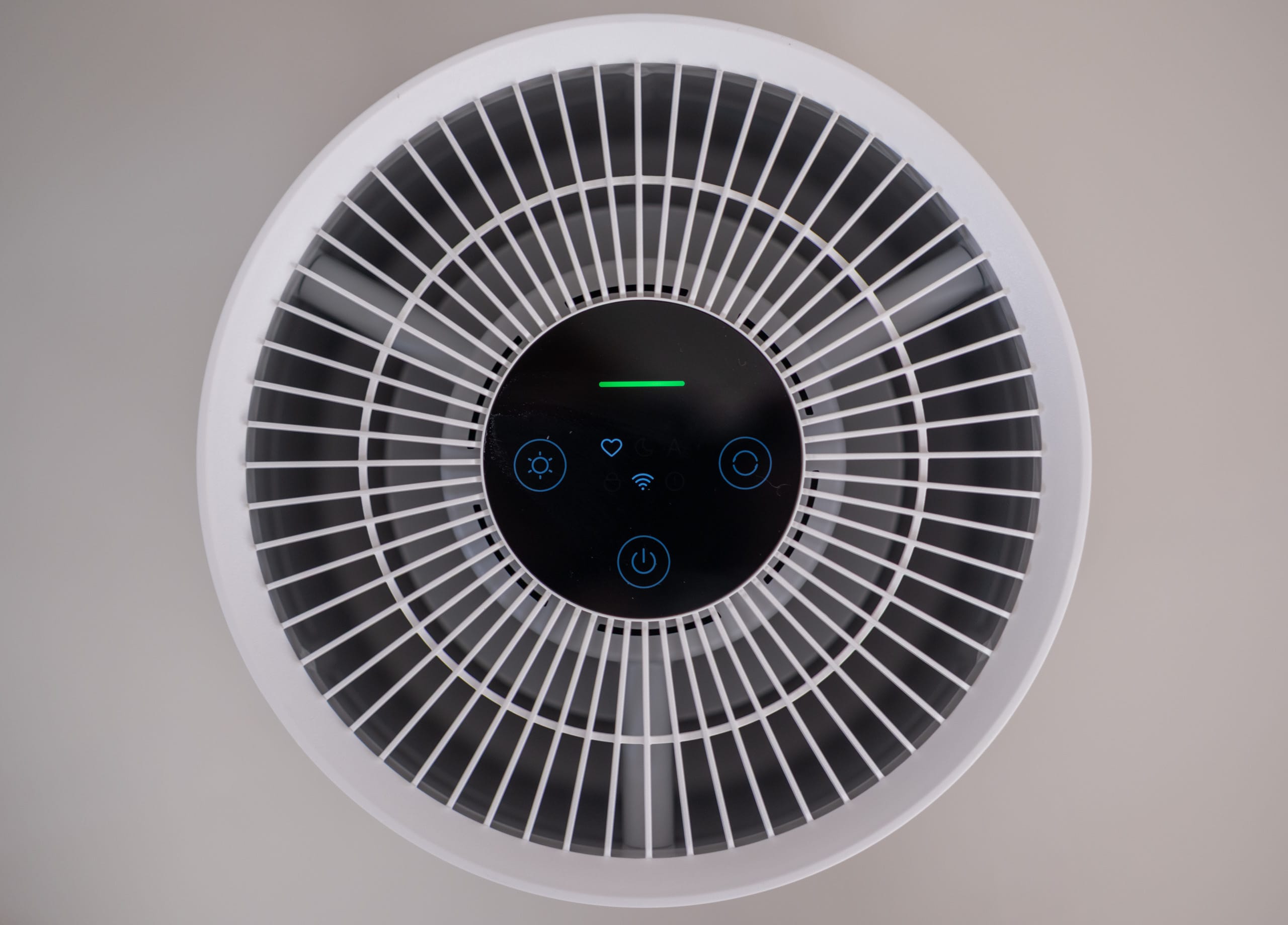
This is where the two devices differ the most, because the Core 300 has no smart features at all. Everything happens on the touch panel on top of the device, where you can turn it on and off, choose fan levels 1-3 or sleep mode, set a 2, 4, 6 or 8 hour timer, turn the backlight off and lock the panel. There’s also a filter indicator, but there is no app, no auto mode and no sensor of any kind. If you want those, Levoit will point you towards the Core 300S, which costs around $50 more.
The 4 Compact connects to 2.4GHz Wi-Fi and is controlled through the Mi Home app, where you can set the exact fan speed, create schedules, check filter life and lock the buttons. It also works with Alexa and Google Home, although both are limited to switching it on and off or changing between Auto, Sleep and Manual modes.
That being said, the 4 Compact’s smart features have real limits. Its infrared PM sensor (made by Pulse Sensor) only shows a status label such as “Good” or “Poor” rather than a number, and its auto mode is far too lenient. In my testing, auto and sleep mode both stalled at around 40-50 µg/m³ after two hours. You also can’t trigger automations from its own sensor, so unless another Xiaomi device feeds PM2.5 readings into Mi Home, you’ll be setting the speed yourself. Still, remote control and schedules are more than the Core 300 offers.
Design & Size

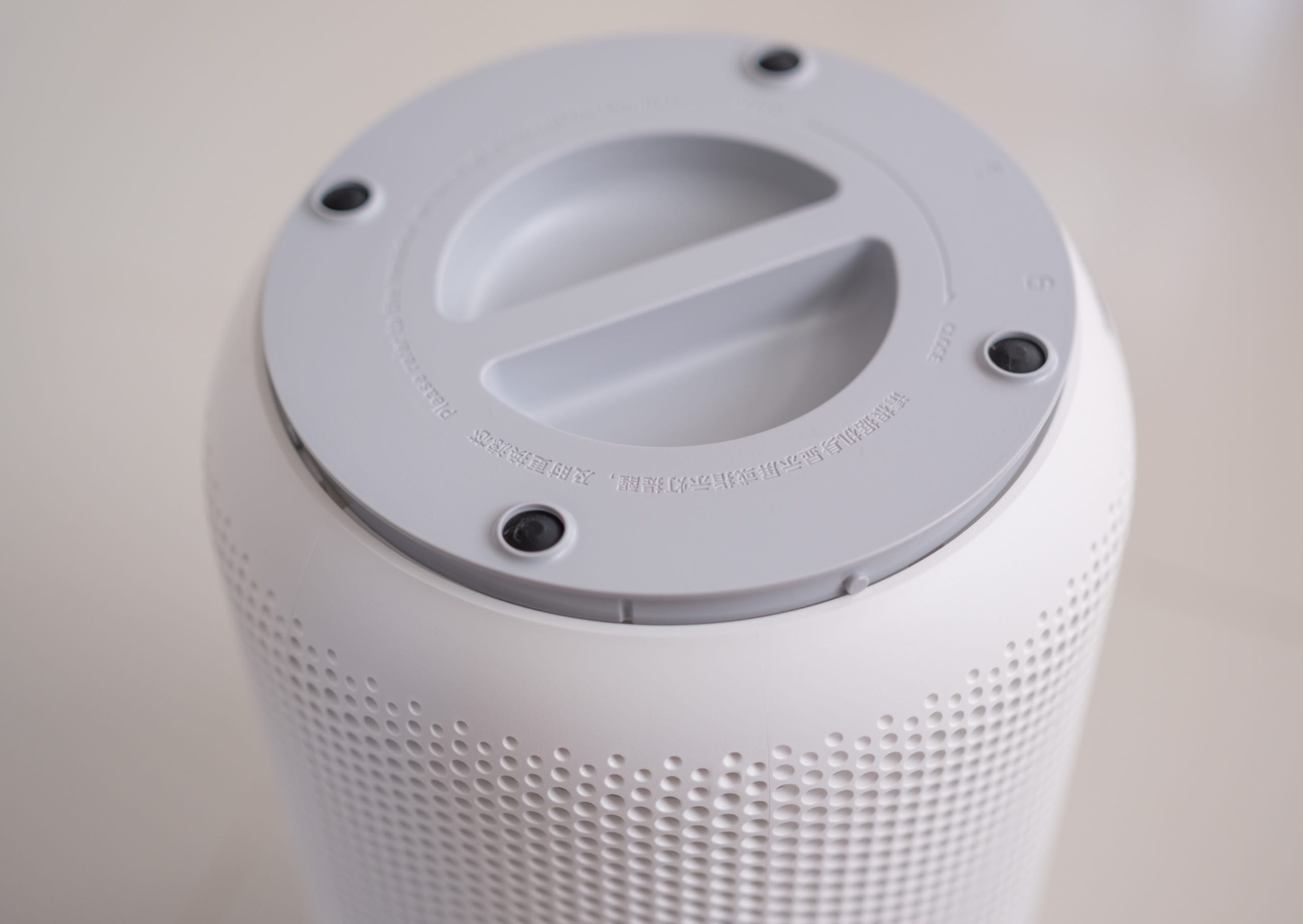
On paper, these two devices are almost exactly the same size, but they feel very different in the hand. The Core 300 measures 22 x 22 x 36 cm and weighs 3.39 kg, while the 4 Compact measures 22 x 22 x 35.5 cm and weighs just 2.2 kg. That makes the Core 300 over a kilogram heavier, and the 4 Compact is light enough to sit on a shelf or desk, which is how I use mine.
Changing the filter also works slightly differently. On the 4 Compact, you twist a handle on the bottom and the filter comes out attached to the base plate. On the Core 300, you rotate off a separate base plate first, and it’s quite easy to dislodge the filter in the process. I prefer the Xiaomi approach, although I do like the foam seal on top of the Core 300’s filter, which stops air from bypassing it.
One more difference is worth knowing about if you have pets. The Core 300’s power cable is non-removable, so if it gets chewed, you’ll be replacing the whole device rather than a cable, while the 4 Compact uses a separate adapter with a barrel plug. My cats prefer to sit on top of the 4 Compact, which tends to turn it off or switch modes, so I now keep its screen locked.
Pricing & Running Costs
Prices are official retail in a Western market: US where the device is sold there, Europe where it is not. Other regions differ, sometimes sharply.
Price is where this comparison gets interesting, because the cheaper device to buy isn’t the cheaper device to own. The Core 300 lists at $99.99 and is often discounted to $80-90, while the 4 Compact typically sells for $99-120 in North America and Europe. The charts in this section use the US list prices ($99.99 and $119.99). Here in the Philippines, the order flips, and the 4 Compact costs ₱3,999 (around $66) against around ₱5,500 for the Core 300.
At US list prices, the Core 300 is the better deal per m³/h of clean air, at around $0.39 against $0.56 for the 4 Compact. It’s cheaper to buy and moves more air at max speed, so on the purchase price alone it’s hard to argue with.
Prices are official retail in a Western market: US where the device is sold there, Europe where it is not. Other regions differ, sometimes sharply.
Electricity changes the picture. The Core 300 draws 35 W at max, 24 W at half speed and 2 W in sleep mode, against 25 W, 9 W and 2 W for the 4 Compact. Since the two clean at the same rate at half speed, that means the Core 300 uses over two and a half times the electricity for the same clean air at the setting most people leave a purifier on.
On my usual assumptions (half speed, twelve hours a day, at $0.29/kWh), the Core 300 costs about $30 a year in electricity against $11 for the 4 Compact. Add filters every six months ($30 for the Core 300 and $25 for the 4 Compact), and the Core 300 costs about $90 a year to run against $61. That gap pays back the 4 Compact’s extra $20 in about eight months, and over five years the 4 Compact works out roughly $125 cheaper to own.
Electricity assumes half speed, twelve hours a day, at $0.29/kWh. Filters use the most conservative manufacturer interval, which for both is six months. Prices are official retail in a Western market: US where the device is sold there, Europe where it is not. Other regions differ, sometimes sharply.
There is one important caveat. 4 Compact filters on Amazon can cost up to $40, and at that price the 4 Compact’s running costs rise to about $91 a year, almost exactly level with the Core 300. If that’s what you’ll pay, the Core 300 becomes the cheaper device to own because it’s cheaper to buy, so check filter prices where you live before deciding.
Prices are official retail in a Western market: US where the device is sold there, Europe where it is not. Other regions differ, sometimes sharply.
Conclusion – Is the Xiaomi 4 Compact or Levoit Core 300 Better?


If you want the most cleaning power for your money and don’t care about smart features, the Core 300 is the better purifier. It moves around 19% more air at max speed, cleared my test room more than five minutes faster, and costs less to buy at US list prices. Its performance is also independently verified by AHAM, and in my testing it beat its own claim.
However, the 4 Compact makes more sense if you plan to run your purifier at half speed for hours every day. At that setting the two clean at the same rate, but the 4 Compact is quieter, uses less than half the power and, with $25 filters, costs less to own within a year. It’s also the only one of the two with an app and schedules, and it’s light enough to sit on a shelf or desk. Here in the Philippines, where it’s the cheaper device to buy as well, it’s the easy choice.
As I mentioned in my Core 300 review, there is a third option if you want the Core 300’s power with smart features. The Core 300S adds an app, an auto mode and a far more efficient motor for around $50 more, and if you can find it on sale, it’s the one I would point most people towards.
Whichever device you choose, keep it to a room of around 21 m² or less and close the door while it runs, as neither is built to clean an open-plan space.
Xiaomi 4 Compact vs Levoit Core 300 FAQ
Is the Levoit Core 300 more powerful than the Xiaomi 4 Compact?
Yes, at max speed. In my testing, the Core 300 delivered 258 m³/h against the 4 Compact’s 216 m³/h. At half speed, the two were almost identical at 142 and 141 m³/h.
Which is quieter, the Core 300 or the 4 Compact?
The 4 Compact, by 2-3 dBA. I measured 56 dBA against 59 dBA at max speed, and 45 dBA against 47 dBA at half speed.
Which is cheaper to run?
The 4 Compact. At half speed it draws 9 W against the Core 300’s 24 W, and on my assumptions it costs about $61 a year to run against $90 for the Core 300.
Does the Levoit Core 300 have an app?
No. The Core 300 has no app, auto mode or sensor, and Levoit’s Core 300S adds all three. The 4 Compact connects to the Mi Home app.
What size room are they good for?
AHAM recommends the Core 300 for rooms of up to about 21 m² (222 ft²), and Xiaomi rates the 4 Compact for 16-27 m². Both work best in a small room with the door closed.


