

After buying the Mijia Smart Air Purifier 6 and the Xiaomi Smart Air Purifier 4 Lite, I went down a bit of a rabbit hole with Xiaomi’s air purifier lineup. Both devices impressed me, but they were covering our living area and bedroom respectively, which left my office without anything. Coincidentally, my office is also the room that is most impacted by outdoor air pollution and I wanted clean air while I work too, so I started looking at what else Xiaomi had to offer. That led me to the 4 Compact, the smallest and most affordable purifier in the lineup.
Part of what sold me on it was the size. My office isn’t a large room, and I’d been looking for something that could sit on a shelf rather than take up floor space. The 4 Compact is compact enough (who would’ve guessed?) to do exactly that, which made it the natural choice. Soon after coming to this realisation, I picked one up from the local Xiaomi store. Now, I do want to note that I purchased my device here, in the Philippines, for 3999 Pesos – less than 70 USD. It’s important that I mention this immediately, because this is much less than the device costs in western markets (unless you can find it on sale) and influenced my thoughts on the device.
Anyway, I went into my testing with reasonable expectations, though not without some scepticism. The other two Xiaomi purifiers had performed well enough that I trusted the brand, but the 4 Compact is a noticeably smaller machine and physics don’t lie. A smaller fan moving less air through a smaller filter is always going to have limits, and I wasn’t sure it could make a meaningful difference even in an office-sized space. So I’ve been running it for just under a month with that question in the back of my mind. Here’s what I found.

I independently review air quality monitors with a focus on accuracy. I’ve tested well over 50 devices, compared some of them against reference instruments, and rely on peer-reviewed research and third-party studies wherever possible.
I don’t accept sponsored posts or paid reviews, and I don’t run ads on BreatheSafeAir. When I receive a free product, the company has no say in what I write. Affiliate links don’t influence my views and never increase the price you pay.
I’m constantly learning about how these sensors work – from opening them up, discussing with researchers in the field and examining the hardware inside. That ongoing learning process helps me write reviews that are grounded in how the technology actually behaves, not just what the spec sheet says.
You can read my full Disclaimers & Ethics page for complete details. And as with any review, even mine, I always encourage checking multiple independent sources before making a decision.
This post contains affiliate links. For more information, please refer to my affiliate disclaimer. I was NOT sent a product for review; I purchased this product myself. All opinions expressed in this post are my honest thoughts. I only recommend products that I believe in.
Informational Purposes: Information on this blog is for informational purposes only. Readers are encouraged to confirm the information herein with other sources. This website assumes no responsibility for the accuracy of the information, which is subject to change without notice. Products mentioned on this website are not medical devices and do not guarantee protection.
If you notice any errors or inconsistencies in this article, please contact me so I can update the information accordingly.
Contents
Performance
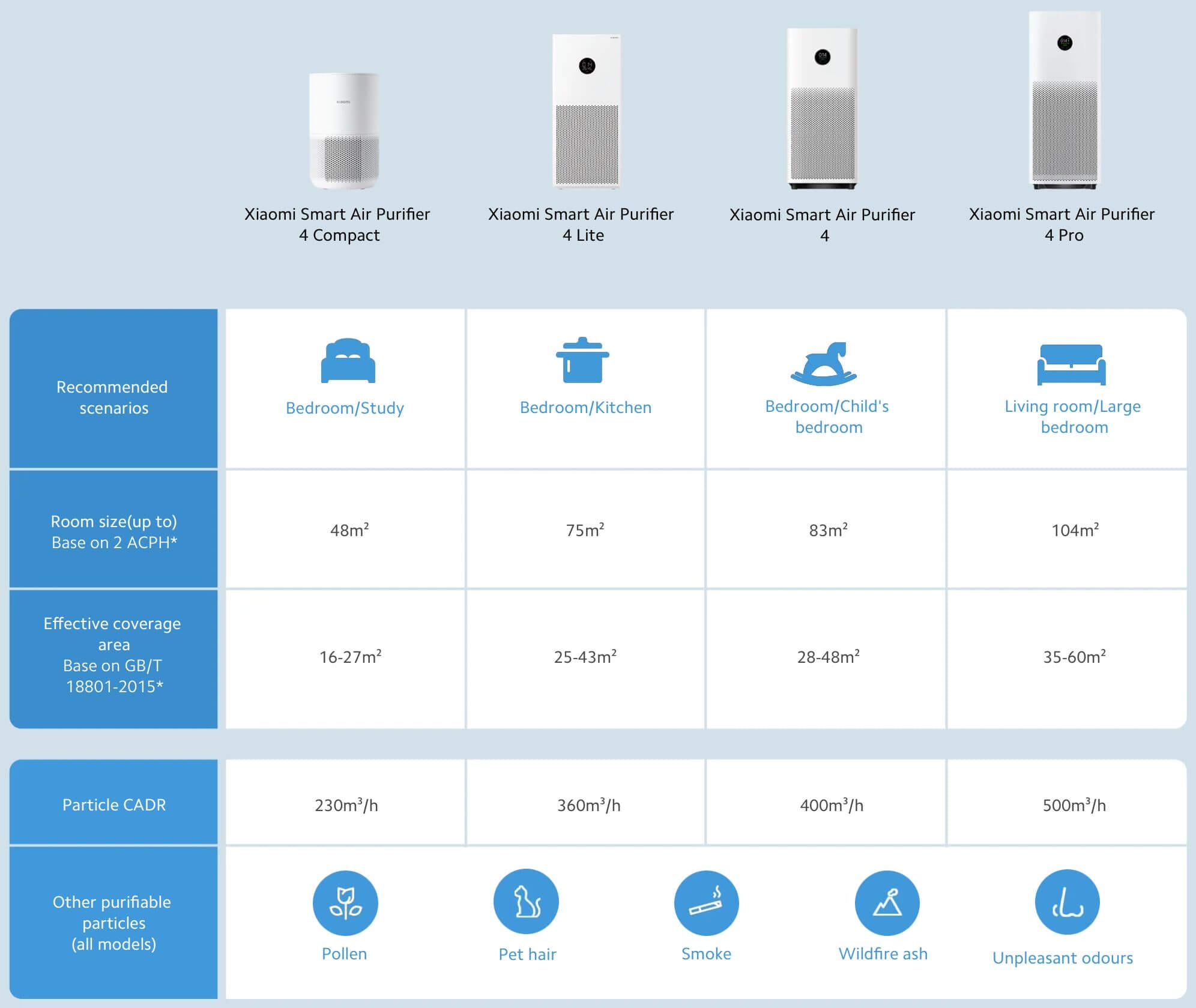
Xiaomi rates the 4 Compact at a particle CADR of 230 m³/h and an effective coverage area of 16-27 m², with a room size rating of up to 48 m² based on two air changes per hour. To put that in perspective against the 4 Lite, which I’ve already tested in the same conditions, the Lite’s CADR is 360 m³/h with coverage up to 43 m² – about 57% higher by CADR and 59% larger by effective coverage area.
Of course, manufacturers should not be fully trusted, so to see how the 4 Compact actually performs, I ran it through the same test I used for the 4 Lite and the Mijia 6. I placed the purifier in the centre of my spare bedroom measuring 29.4 m³, burned incense until the PM2.5 concentration reached around 500 µg/m³, then set the device to a specific speed and measured how long it took for concentrations to fall below 5 µg/m³. Every reading comes from a single AirGradient ONE I-9PSL, factory calibrated, sitting in the room with the purifier, and I ran each speed three times.
| Series | Runs | Measured CADR | To 50% | To 90% | To 99% |
|---|---|---|---|---|---|
| Xiaomi 4 Compact, max speed | 3 | 216 m³/h | 6:12 | 18:01 | 32:01 |
| Xiaomi 4 Lite, max speed | 3 | 350 m³/h | 3:56 | 11:36 | 21:02 |
| Levoit Core 300, max speed | 3 | 258 m³/h | 4:52 | 14:54 | 26:42 |
| Provirtec Pawtent Pro, max speed | 3 | 241 m³/h | 5:30 | 16:24 | 28:43 |
Measured CADR is the median of 3 runs, fitted to the exponential part of each decay curve in a 29.4 m³ room. A real room isn't a sealed test chamber, so my figures won't line up exactly with a lab result, and a difference here doesn't mean the manufacturer is wrong.
29.4 m³ · AirGradient ONE I-9PSL (factory calibrated) · Download xiaomi 4 compact, max speed data (CSV) · Download xiaomi 4 lite, max speed data (CSV) · Download levoit core 300, max speed data (CSV) · Download provirtec pawtent pro, max speed data (CSV) · Download no purifier, room alone data (CSV)
The 4 Compact is the slowest of the four, which is what its size and CADR rating would lead you to expect.
At max speed the 4 Compact took 32 minutes to bring the room under 5 µg/m³, and 54 minutes at half. That works out to 216 m³/h of measured clean air delivery against the 4 Lite’s 350, so the Lite clears the same room in 21 minutes and the Compact needs half as long again. Xiaomi claims 230 m³/h for this one and 360 for the Lite, so both come in a little under their ratings by roughly the same margin. Their numbers are honest enough, which is not something I can say about every brand.
| Series | Runs | Measured CADR | To 50% | To 90% | To 99% |
|---|---|---|---|---|---|
| Max speed | 3 | 216 m³/h | 6:12 | 18:01 | 32:01 |
| Half speed | 3 | 141 m³/h | 9:33 | 27:03 | 54:23 |
Measured CADR is the median of 3 runs, fitted to the exponential part of each decay curve in a 29.4 m³ room. The manufacturer states 230 m³/h. A real room isn't a sealed test chamber, so my figures won't line up exactly with a lab result, and a difference here doesn't mean the manufacturer is wrong.
29.4 m³ · AirGradient ONE I-9PSL (factory calibrated) · Download max speed data (CSV) · Download half speed data (CSV) · Download room alone data (CSV)
The chart above covers max and half speed only. From my earlier round of testing I also ran Sleep and Automatic mode, and neither impressed. Neither managed to bring concentrations below around 40-50 µg/m³ even after two hours, a long way from the sub-5 µg/m³ mark that both maximum speed and half speed reached. Auto mode is one of my consistent complaints about Xiaomi’s purifiers generally – the thresholds at which it ramps up and down just aren’t aggressive enough to be useful. I noticed the same with both the 4 Lite and Mijia Smart Air Purifier 6. But before I digress too much, we will address that further in the Sensor Performance section.
Something I didn’t expect was sleep mode outperforming auto over the two-hour test. Auto mode should generally run at a higher fan speed, so I expected it to win. With some doubt in my mind, I reran the test and saw the same behaviour both times, so I don’t believe it to be a fluke. My best guess is that auto mode’s speed cycling works against it – the fan ramps up, the sensor decides things are fine, it drops back down, and that loop repeats without settling into an efficient rhythm. Sleep mode just runs at a fixed, quiet pace and gets there slowly but steadily. The IR PM sensor’s limited accuracy could also be playing a role here, triggering speed changes based on readings that aren’t entirely reliable. I can’t say for certain what’s going on, but it’s an interesting observation.
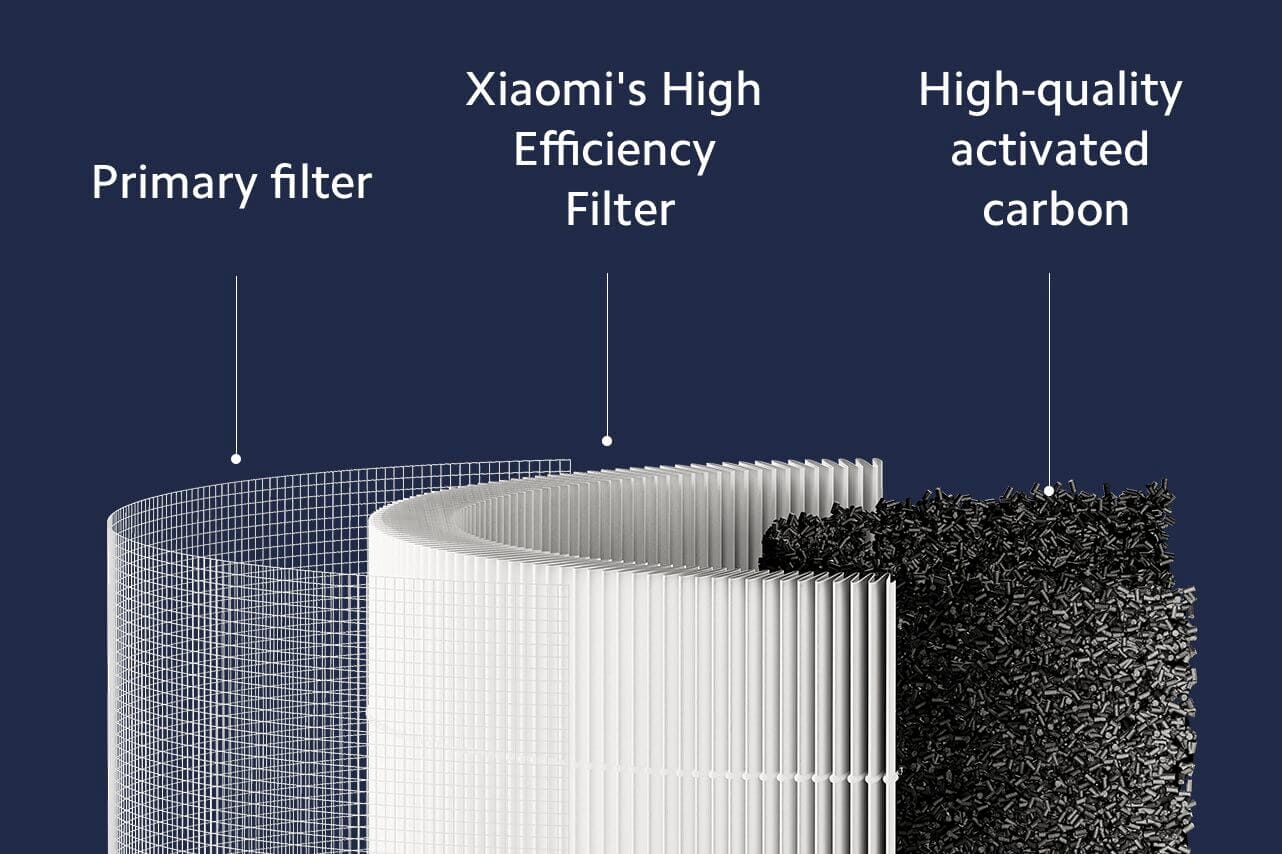
Looking at the filter technology, Xiaomi claims the filter combines electrostatic and mechanical filtration, removing 99.97% of particles down to 0.3 microns and up to 99.99% at 0.1 microns. There’s also a carbon layer included, though given the overall size of the filter I wouldn’t expect it to contribute meaningfully for long. Carbon reaches its adsorption capacity well before the main filter medium wears out, so treat that as a minor bonus and don’t purchase this device if VOCs are your primary concern.
The 4 Compact does clean the air. It’s just slow relative to larger devices, and that’s physics more than a design flaw. My office is roughly 4 x 4 metres, and the purifier handles that space well when the room is properly sealed. When I cracked a window on a day with slightly elevated outdoor PM2.5 of around 15 µg/m³ the device struggled to maintain good air quality (< 5 µg/m), which isn’t surprising but is worth being aware of. It really needs a well-sealed space to do its job properly.
Also worth noting is that the extreme purification test shared above is useful for understanding the ceiling of what a device can do, but it’s not how most people actually use an air purifier. In normal day-to-day use, the goal is maintaining clean air rather than recovering from a spike of 500 µg/m³. In that more realistic scenario, the 4 Compact holds up well as long as it’s suited for the space. My office used to sit between 5-10 µg/m³ most of the time, and since running the purifier it’s stayed consistently below 3 µg/m³, except when we’re cooking or the windows are open and the outdoor PM2.5 is elevated. For a small, well-sealed room, the Compact 4 can perform.
BreatheSafeAir is a one-person publication. Every share and every subscriber is important to me.
I don’t have a marketing budget or a team behind me. Just a lot of test equipment and a genuine interest in helping you make sense of your air quality. If you find this useful, subscribing to my newsletter is the best free way to support the work. You’ll get information on what I’m currently testing, findings that don’t make it into the full reviews, and the kind of detail you only get from someone who thoroughly tests these devices.
Sensor Performance
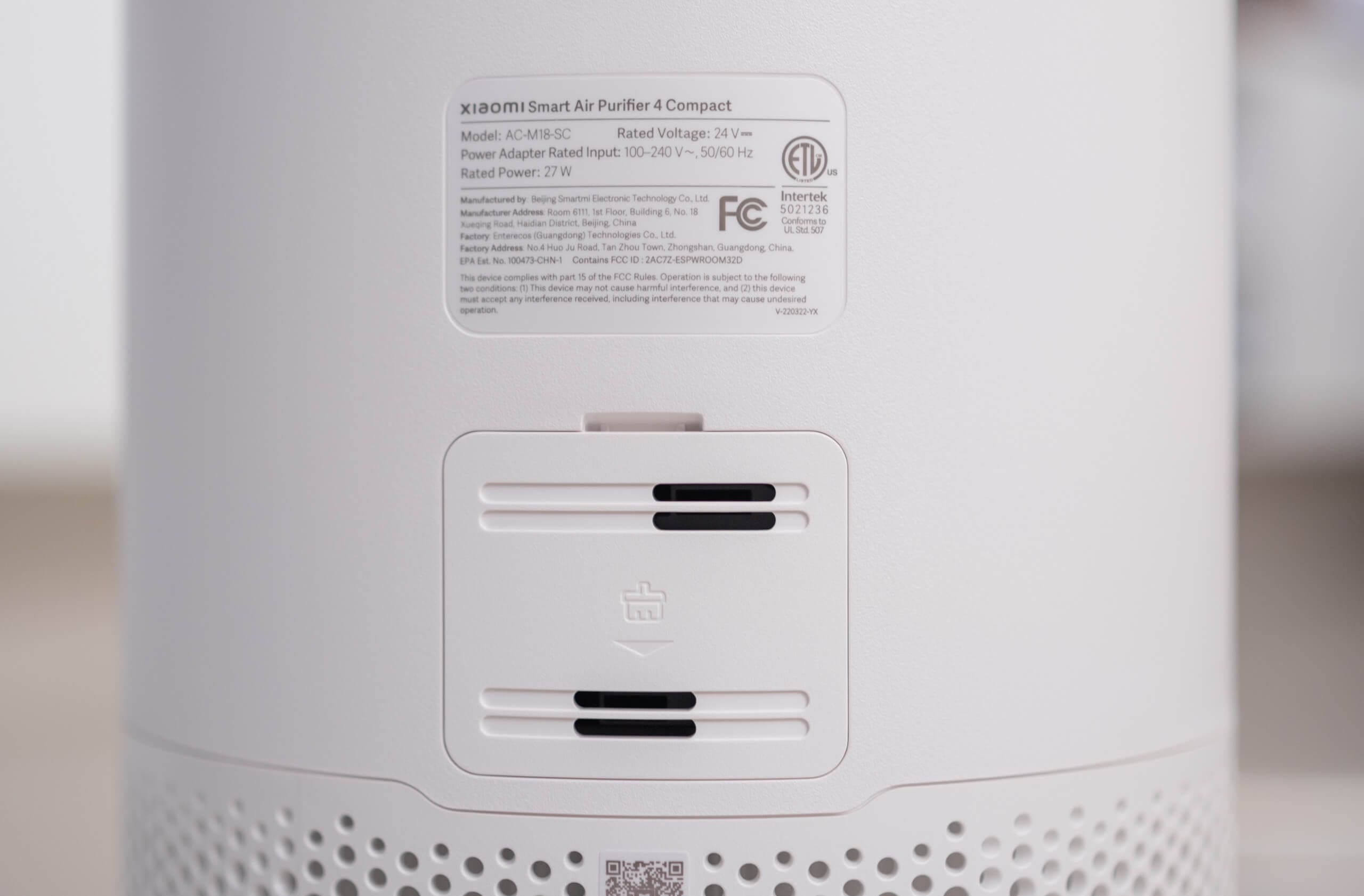
The 4 Compact has a PM sensor made by Pulse Sensor, sitting behind the removable cover on the back of the device. Unlike the sensors in the 4 Lite and the Mijia 6, this one uses infrared detection rather than laser scattering. Infrared sensors are generally less sensitive and struggle more with fine particles (such as PM2.5). Likely for this reason, instead of seeing a concentration in µg/m³, you will get a status label like “Good” or “Poor.” If you have other Xiaomi air purifiers in your Mi Home ‘home’ you will see a combined score instead.
I understand the limitations of Infrared sensors and, partially, why Xiaomi has therefore decided not to show the PM concentration outside of a broad score, but I also have issues with the scoring system as the thresholds for the labels are also too loose to be very useful. For example, “Good” can cover concentrations that health bodies would consider worth acting on. Assuming the thresholds are the same as the 4 Lite, the ‘Good’ status applies to anything under 35 µg/m³. However, the WHO recommends keeping long-term exposure below 5 µg/m³ as an annual average and under 15 µg/m³ over a 24-hour period. The EPA is less strict, and its 24-hour limit is 35 µg/m³ (perhaps where Xiaomi got this value from), but even its annual exposure guideline is 9 µg/m³. Indoors, I think the annual exposure limits are what we should be aiming to meet. Unfortunately, this makes Auto mode – which relies on these values – almost useless in my mind.
As for the sensor’s actual performance, I can’t say as much as I’d like because the app doesn’t let me export data. Running all three Xiaomi devices side by side, the 4 Compact’s status labels shifted at concentrations that looked broadly consistent with what the 4 Lite and Mijia 6 were reporting numerically. Both of those have tracked reasonably well against dedicated monitors in my testing, so I have some confidence the sensor is functional. But with an infrared sensor and no raw data to work with, I can only go so far.
Design
The 4 Compact is a minimalist, cylindrical device that measures 220mm in diameter and 355mm tall, weighing just 2.2kg. It’s light enough to tuck under your arm if it needs to be moved, and small enough to sit on a shelf or desk without dominating the space. It’s how I use mine, and it works well for that. The cylindrical form is a bit of a departure from the squarer designs of the 4 Lite and the Mijia 6, and it gives the device a cleaner, less utilitarian look.
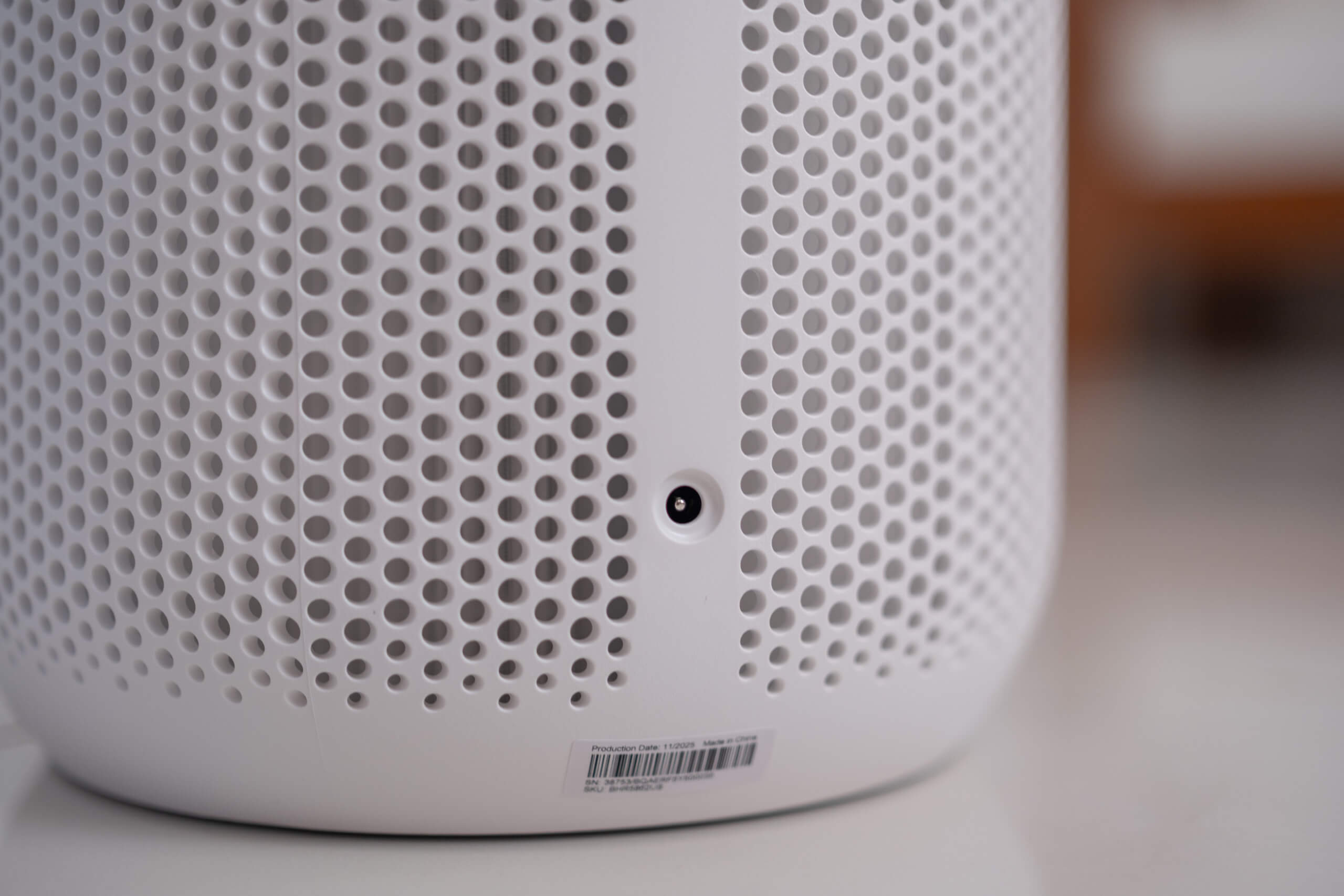
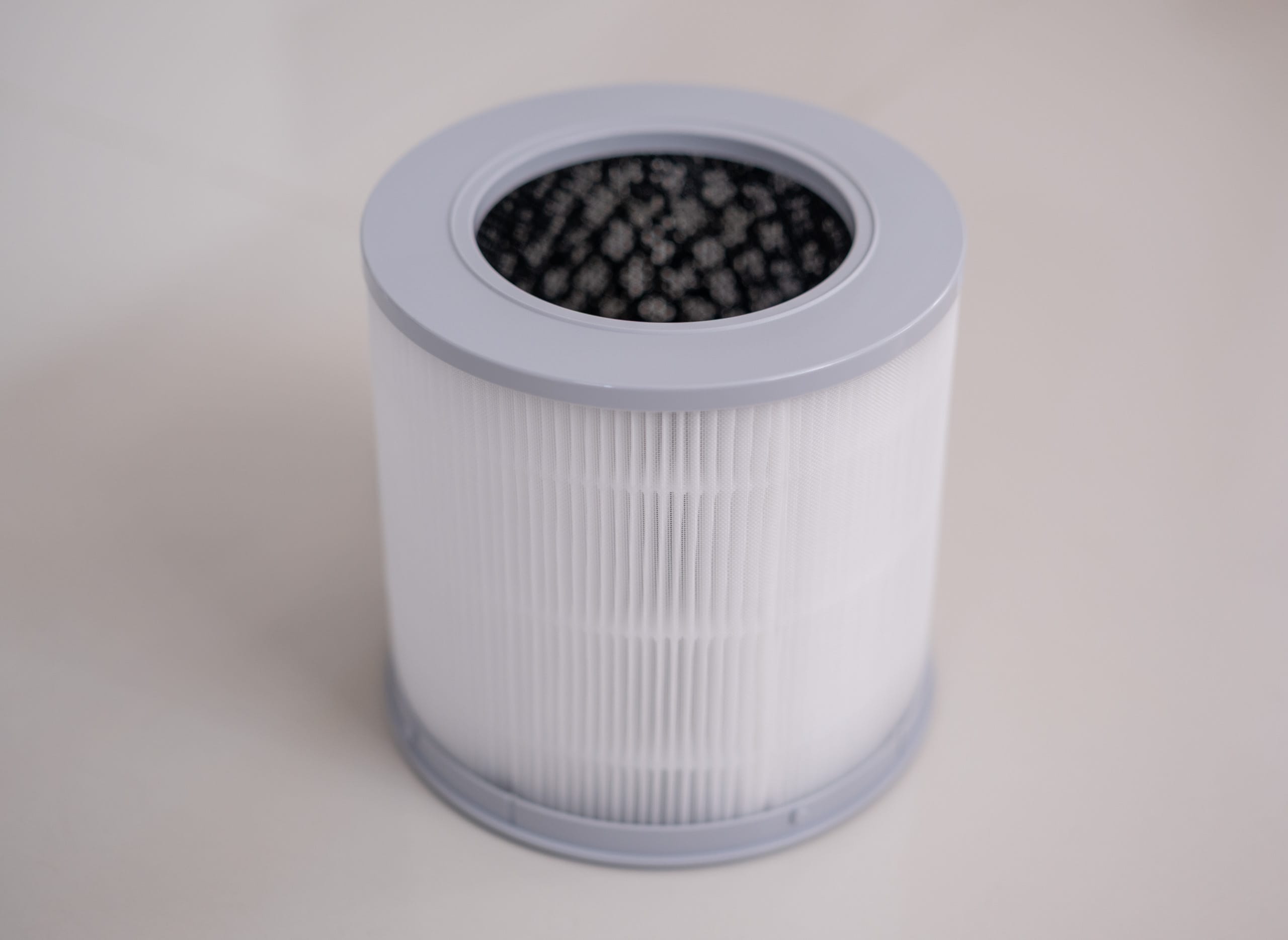
Airflow works the same way as the other purifiers in the lineup. There’s 360-degree venting around the lower section of the device that acts as an intake, drawing air inward through a cylindrical filter before exhausting it upward through the top. Replacing the filter involves twisting a handle on the bottom of the device, after which the whole filter slides downward and out. It’s a straightforward process. It’s worth noting is that this filter is unique to the 4 Compact, so you can’t swap in filters from the 4 Lite or Mijia 6. The Xiaomi website mentions that the filter contains an RFID tag, similar to the Mijia 6’s filters, though I wasn’t able to identify where the tag sits or exactly what it does in practice (but I would guess it’s to monitor filter lifespan in the app).
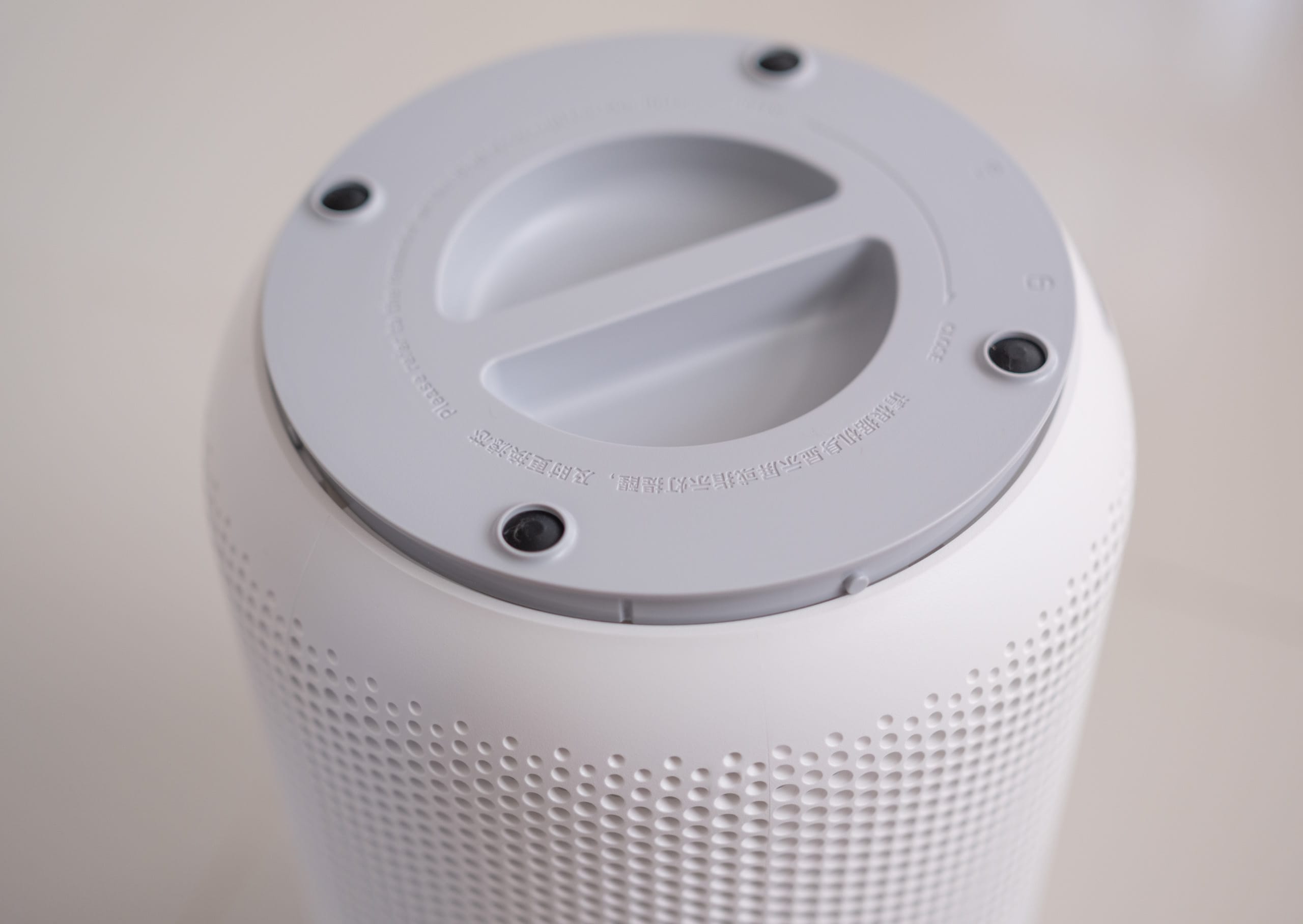
On the back of the device is a barrel power connector where the adapter plugs in, with a small vent and a removable cover above it. Behind that cover sits the PM sensor, which is made by Pulse Sensor. There’s also some regulatory information printed here. On the top, centred within the exhaust, is a small screen with a few touch buttons for powering the device on and off, cycling through modes, and adjusting screen brightness. The display shows the current mode, a few basic status indicators including Wi-Fi, and a colour bar indicating air quality. Unfortunately, you can only switch between Automatic, Sleep and Manual mode here, meaning you can only really set one preset speed. For further adjustments, you will need to use the application.
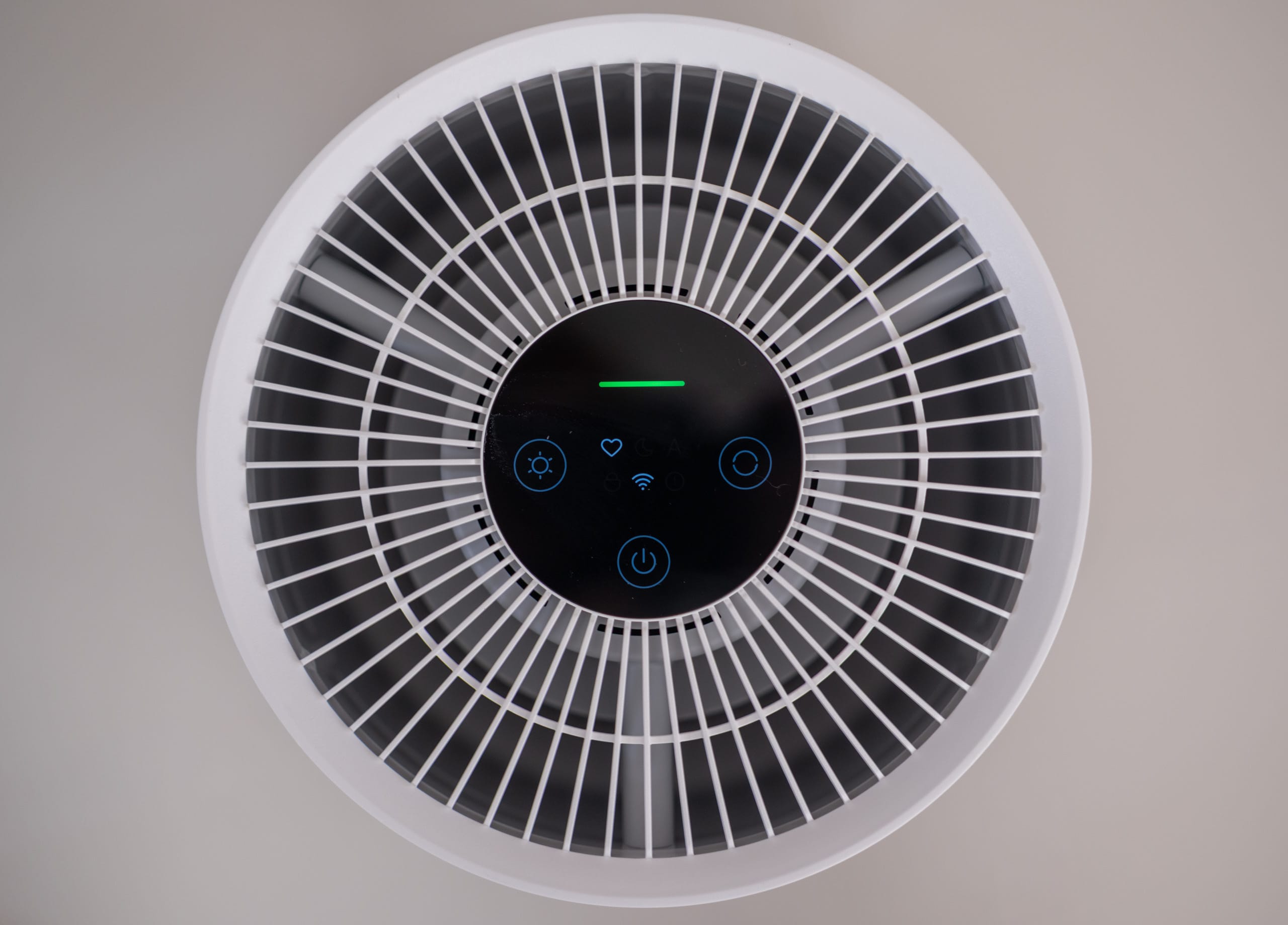
It’s a decent screen and not at all hard to use, though I’ve had one particular issue with it. My cats like to sit on top of the device, and in doing so they frequently turn it off or switch modes without any input from me. You can lock the screen, which is what I now do by default, but I forget to re-lock it after changing settings often enough that it’s become a minor but recurring annoyance. Admittedly, it’s not really a device flaw, though, and perhaps my cats need to be better trained!
One broader point worth making about the design is that the compact size, while convenient, does, of course, have a physical trade-off. A smaller device means a smaller fan, and a smaller fan has to spin faster to move the same volume of air. That tends to produce a higher-pitched sound than you’d get from a larger, slower-spinning fan in a bigger device.
Connectivity & App
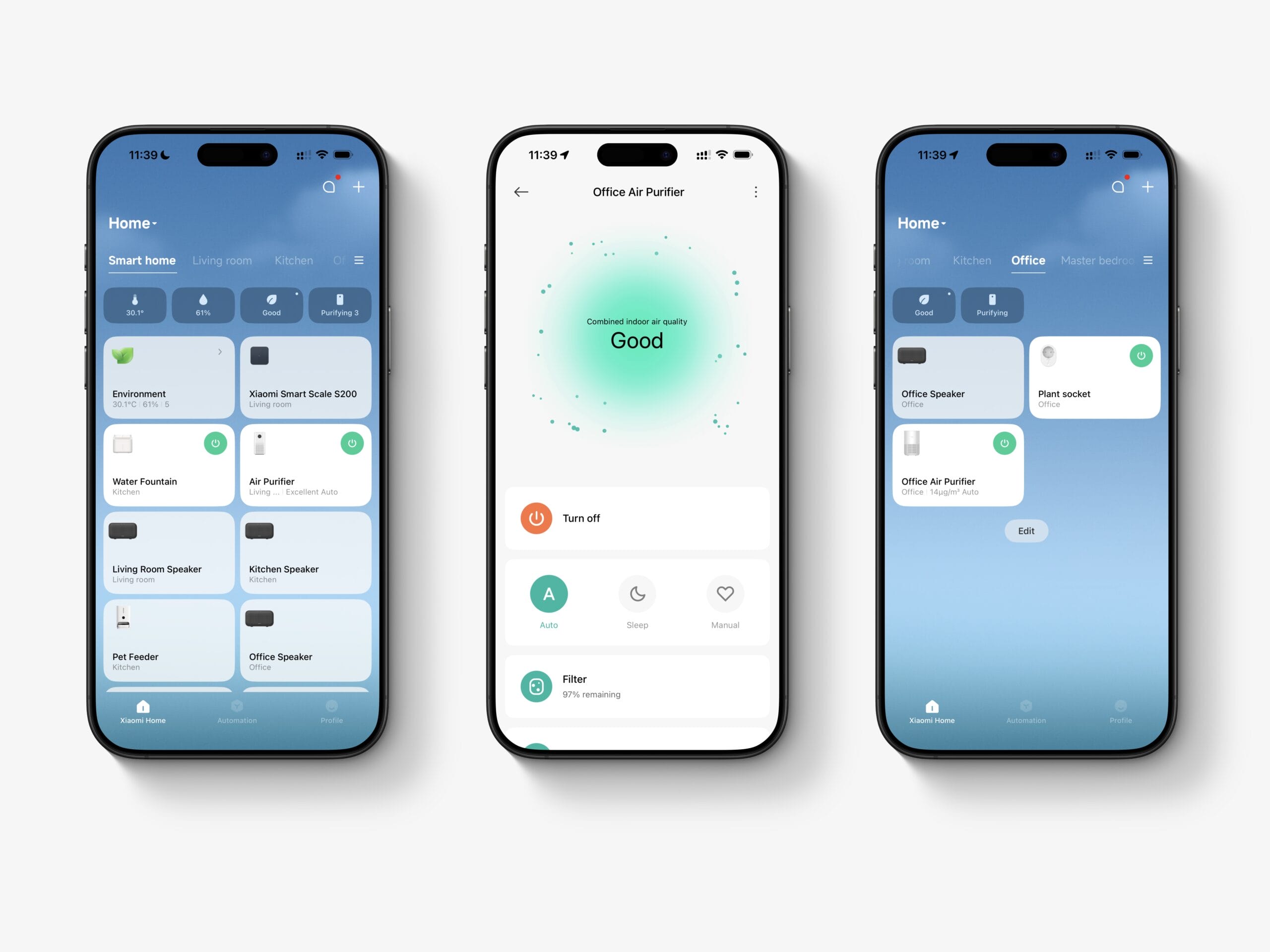
The 4 Compact connects to your home network over 2.4GHz Wi-Fi and is controlled through the Mi Home app, which is Xiaomi’s hub for its entire smart home ecosystem. If you already use other Xiaomi devices, the 4 Compact slots straight in. If you don’t, you’ll need to download Mi Home to get the most out of it, since a fair amount of the device’s functionality sits behind the app. Controlling the manual fan speed, for example, requires you to go into the app as you can’t do it from the device itself beyond switching between the preset modes. Setup is painless though. The device was automatically discovered the moment I opened the app, and it was up and running in a couple of minutes.
Once you’re in, the app gives you remote control over the device, lets you set schedules and automations, check remaining filter life, adjust screen brightness, toggle the child lock and notification sounds, and share the device with other Mi Home users. You can also set up automations that link the 4 Compact with other devices in your home, which is where things get interesting if you have a broader Xiaomi setup. Google Home and Alexa are both supported too, though like the other devices in the lineup, the integration is fairly basic and won’t give you fine-grained control. For example, you will be limited to asking Alexa to swap between Auto, Sleep and Manual modes and can’t ask ‘Alexa, set Office Air Purifier to 50% speed’ – something which frustrates me.
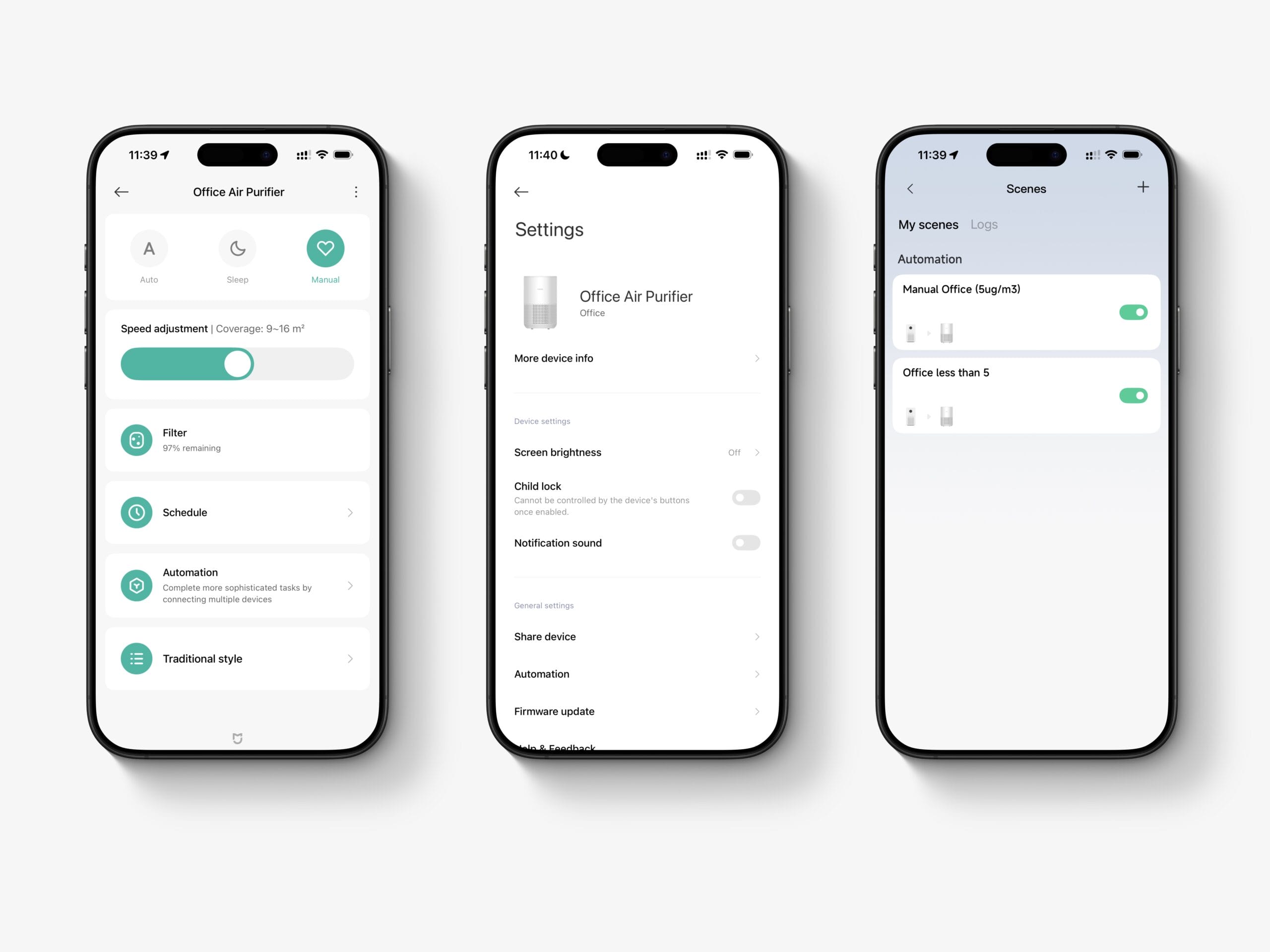
Now, where the 4 Compact differs from the 4 Lite and the Mijia 6 is worth discussing. Unlike those two, the 4 Compact doesn’t display PM2.5 concentrations in the app. You get a status label instead, something like “Good” or “Moderate,” with no number behind it. This carries over into automations as well. With the Mijia 6, I can trigger an automation based on a specific PM2.5 reading. With the 4 Compact, you have no triggers available except for ‘On’ and ‘Off’. I’m fortunate in that I can run automations for the 4 Compact using PM readings from the Mijia Smart Air Purifier 6, but many people won’t have that option and will be stuck adjusting things manually.
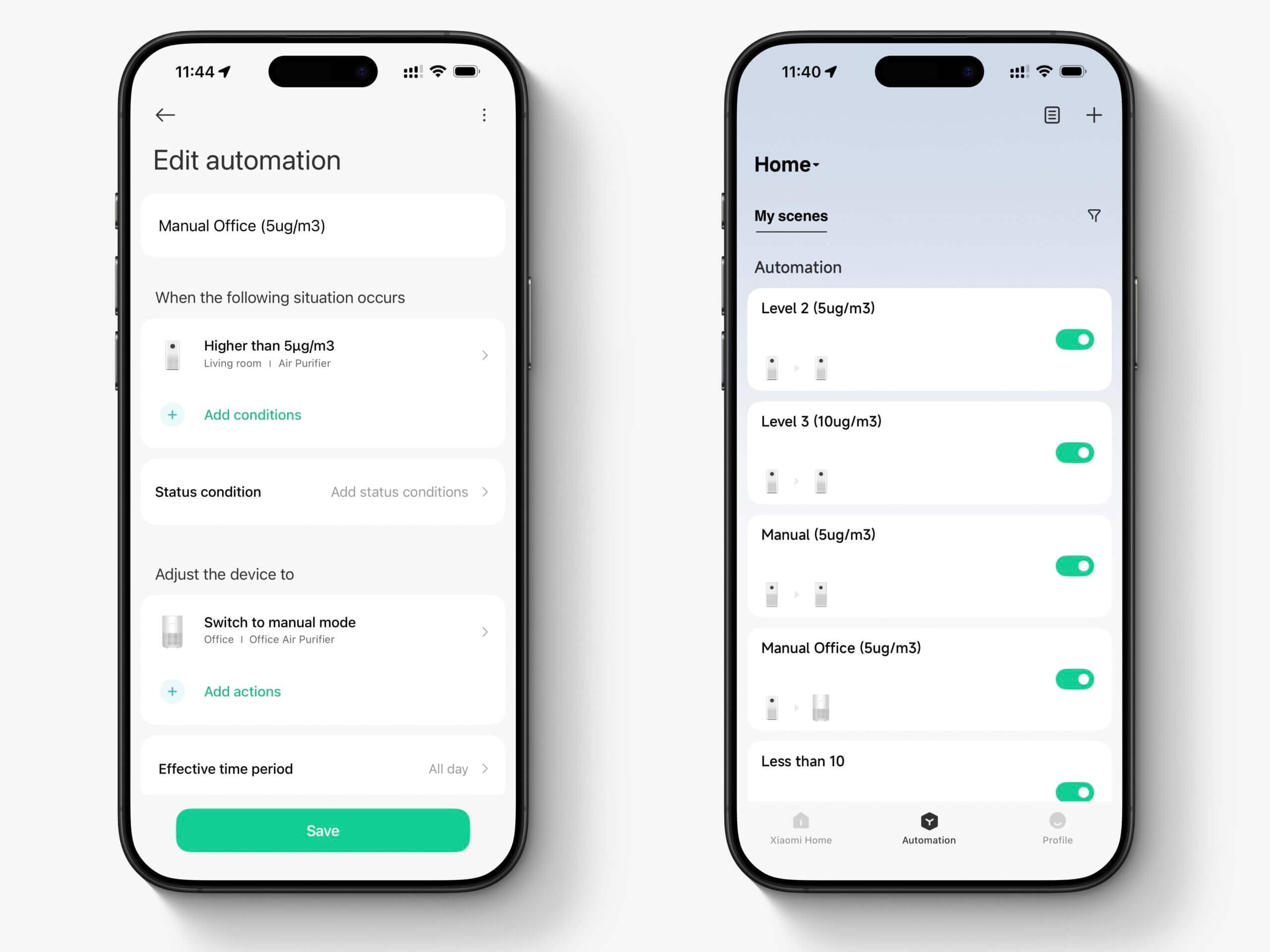
This issue is compounded because the automatic mode is pretty much useless. On the more premium Xiaomi air purifiers, I haven’t found this to be too much of an issue because automations all me to manually set the thresholds at which they adjust speed. However, with the 4 Compact, you’re unable to even set up custom thresholds unless you have another purifier or air quality monitor that integrates with the Mi Home app and has the capability to use its PM2.5 level as a trigger. This feels like an artificial limitation, and I wish Xiaomi at least allowed the broad air quality (Good, Moderate, Poor, etc) status to be used as a trigger.
Unfortunately, this means that, unless the Auto mode thresholds are okay with you, you will need to be manually controlling the device much more than you should. Of course, it’s also possible to set up automations through Alexa or Google Home if you have some kind of air quality monitor that’s compatible.
Pricing & Ongoing Costs
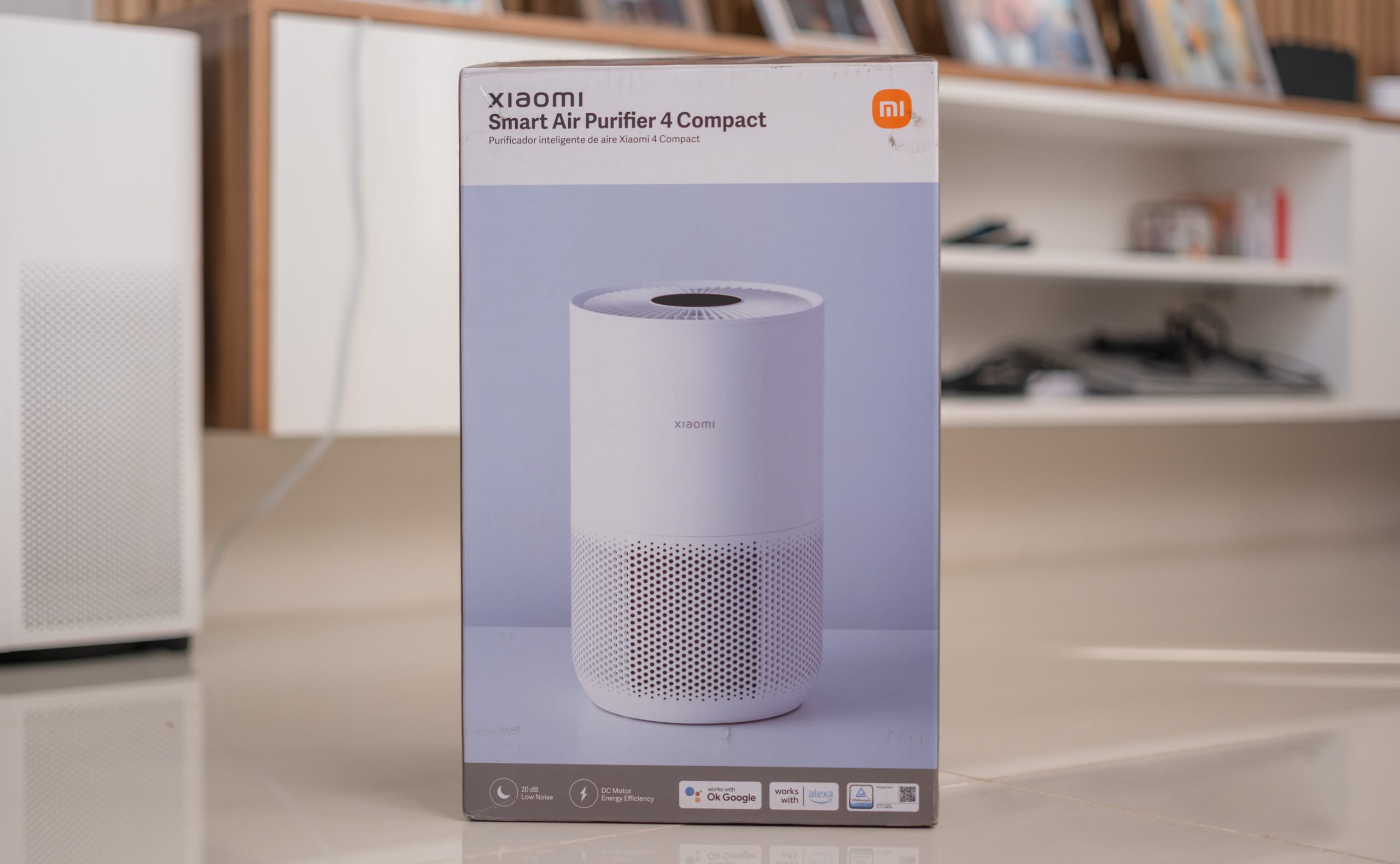
I picked this up for 3,999 pesos, which works out to around $66 USD at the time of writing. That’s the price here in the Philippines, and it’s similarly affordable across much of Southeast and South Asia. In North America and Europe, you’re typically looking at $99-$120 for the same device, which changes the value calculation pretty significantly. It is worth noting, however, that the device does sometimes drop to > $70 when on sale in western markets. The charts below use the Western figure of $119.99 rather than the price I paid, so that every device in them sits on the same basis.
A lot of review sites compare the 4 Compact to devices like the Levoit Vital 100S, and that’s a fair comparison if you’re shopping in a region where both are similarly priced. Other sites have shown the Vital 100S to be a stronger performer, and the Winix A230 is another option worth looking at in the same price range. If you’re in a market where these devices land at similar price points, it’s worth comparing them before committing.
Here in the Philippines though, the Vital 100S costs more than twice what I paid for the 4 Compact. When I tried finding serious competitors at the 3,999 peso price point, I mostly came across brands I’d never heard of and wouldn’t feel confident recommending. At that price, the 4 Compact really doesn’t have much meaningful competition from established names.
So the honest answer is that it depends where you are. In much of SEA and South Asia, this is a hard device to beat for the money. In regions where it retails closer to $100-$120, the math is different and you’d want to look at Levoit, Winix and other brands before deciding. Neither of those is inherently a better fit for everyone, but at similar prices they deserve at least some consideration.
As for power consumption, it is modest across all speeds. At sleep mode or the lowest auto speed the device draws around 2 W, at half speed that rises to 9 W, and at max it settles at 25 W. I reran these a few times because the max figure wandered between 23 and 25 W depending on when I looked.
Nothing here is going to move your electricity bill. The Core 300 is the outlier, pulling 24 W at half speed where the two Xiaomis sit at 9 W, which costs it about three times as much to run at the setting most people leave a purifier on.
Sound is the other thing you notice day to day. I measured 56 dBA at max and 45 dBA at half speed, which makes this the quietest of the four at full tilt. Xiaomi quote 20 dBA for sleep mode and I will take their word for it, because my room’s own noise floor sits well above that. Max speed is audible but not intrusive, and half speed disappears into the background of a home office.
Sleep is left out: every unit read within a couple of dBA of the room’s own noise floor at its lowest setting, which measures the room rather than the purifier.
Being the quietest also comes from being the least powerful, so it is not the win it first looks like.
Filter costs depend heavily on where you buy. Here in the Philippines, replacement filters run around 1,000 pesos, which is reasonable. On Amazon they can go up to around $40, which is harder to swallow albeit still cheaper than some alternatives. Xiaomi recommends changing the filter every 6 to 12 months depending on usage, so you are looking at up to $40 to $80 per year for filter replacements.
Prices are official retail in a Western market: US where the device is sold there, Europe where it is not. Other regions differ, sometimes sharply.
Cheap to buy is only half of it, so here is what each one costs to keep running for a year.
Electricity assumes half speed, twelve hours a day, at $0.29/kWh. Filters use the most conservative manufacturer interval. Prices are official retail in a Western market: US where the device is sold there, Europe where it is not. Other regions differ, sometimes sharply.
The 4 Compact works out cheapest of the four to own, at about $61 a year against $90 for the Core 300. Its filters are the same price as the 4 Lite’s, and it draws less power, so nothing here is surprising.
Conclusion
The 4 Compact is a good little purifier if you’re using it in the right context. For a small room or as a supporting device alongside something more capable, it does what it’s supposed to do and does it at a price that’s hard to argue with – at least in markets like mine. If you’re in North America or Europe paying closer to $100–$120, the value equation shifts and the alternatives deserve more of your attention. That isn’t to say the Smart Air Purifier 4 Compact is a bad choice in these regions, just that there is more competition. If you can stretch the budget, the Levoit Vital 200S-P moved 387 m³/h in the same room against this one’s 216, though it costs roughly twice as much.
My main frustrations with the 4 Compact are with the software side of things. Auto mode is too passive to be useful, and the Mi Home automation options for this device are more limited than they should be. If you only have this device and no other Xiaomi purifier feeding finer measurements into your smart home setup, you’re basically stuck adjusting the speed manually. These aren’t deal breakers at the price point, but they’re worth knowing about before you buy. You might find yourself fiddling with the manual fan speed slider more often than you’d expect.
One thing worth checking before you commit is how close in price the 4 Lite is in your market. In some regions the price gap between the two is small enough that stepping up makes sense, and you’d get more power, more data, and more useful automation options for not much more money. If the gap is wide, or if you’re working with a strict budget, the 4 Compact stands on its own. The same goes if you specifically need something small enough to sit on a shelf or desk – that’s a big advantage the 4 Lite can’t match.
Xiaomi Smart Air Purifier 4 Compact FAQ
Is the Xiaomi Smart Air Purifier 4 Compact good for large rooms?
No. With a CADR of 230 m³/h and an effective coverage area of 16–27 m², it’s designed for small spaces. Think a home office, a small bedroom, or a studio apartment. In my testing, it also struggled to maintain good air quality when a window was cracked open, so sealing the room matters.
Does the Xiaomi 4 Compact show PM2.5 readings?
Not in any useful way. The app shows a status label like “Good” or “Poor” rather than an actual concentration in µg/m³. A number does briefly appear in the Mi Home room overview, but disappears as soon as you tap into the device. If you need real PM2.5 data, you’ll want a dedicated air quality monitor or a different Xiaomi purifier.
Can I use the Xiaomi 4 Compact with Google Home or Alexa?
Yes, both are supported. The same caveats apply as with the other Xiaomi purifiers though – control is fairly basic and you can’t set automations based on PM2.5 concentration through either platform.
How does the Xiaomi 4 Compact compare to the 4 Lite?
The 4 Lite is around 57% faster by CADR and covers a larger area, which my real-world testing confirmed pretty closely. The 4 Lite also shows actual PM2.5 readings in the app and supports more useful automations. In markets where the price gap between the two is small, the 4 Lite is worth the step up.
Is the Xiaomi 4 Compact worth buying?
It depends on where you are. In the Philippines and much of Southeast Asia, where it retails around $65–70, it’s genuinely good value for a small room. In North America or Europe at $100–$120, the competition is more meaningful and you’d want to compare it against devices like the Levoit Vital 100S before deciding.


