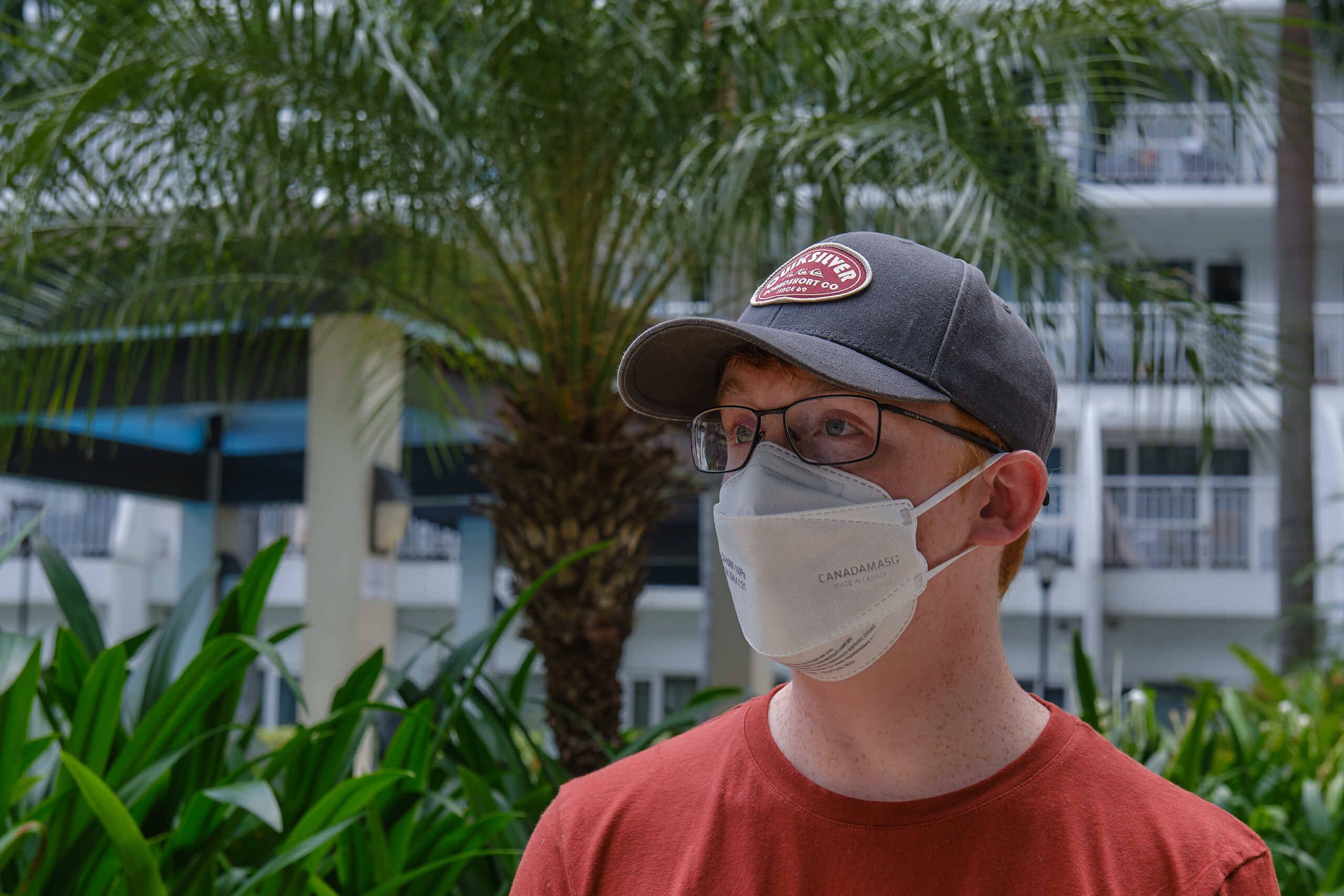
Over the years, many of us have become accustomed to ‘standard’ masks & respirators. Whether you regularly wear a 3M Aura, Powercom KN95, or a Kleenex KF94, nearly all of the key features across these products are identical – they all feature elastic earloops (or headbands), are made from similar materials, and have wire nosepieces.
While there is some innovation in masks – for one, the change of some masks from melt-blown filters to nanofibre – the core fundamentals remain the same. However, one company has set out to disrupt the industry and change our perception of what masks are.
ReadiMask, made by Global Safety First, has created one of the few truly innovative masks on the market. The mask, a strapless one which seals with a skin-friendly adhesive, made me rethink what masks are when I first tried it in early 2023. Almost four years later, it still holds that title.
I’m not the only one who thinks this, either. The ReadiMask 365 was a winner in Phase 2 of BARDA’s Mask Innovation Challenge, a contest run with NIOSH to find designs that push respiratory protection forward. With this award under its belt, I was intrigued by the concept of a strapless mask. Of course, I wanted to try it! Now, almost four years later, I’m still using these masks, and at this point I know them very well.
A lot has changed since I first published this review in February 2023. The NIOSH approval (these masks were previously N95) has been voluntarily withdrawn (more on that below), an Eye Shield version has launched, and the masks are now sold directly by Global Safety First as opposed to through distributors/resellers. This whole review has now been updated to reflect these changes and my experiences over the past four years.
With these things clarified, let’s dive into the review! Is the ReadiMask as innovative as it’s made out to be, or is a more standard mask or respirator still the best choice for respiratory protection?
Please note that the ReadiMask website can only process orders in the U.S. and Canada. If you want to purchase the mask from another country, please reach out to [email protected].
This post contains affiliate links. For more information, please refer to my affiliate disclaimer. I was sent a product for review, but the article is not sponsored. All opinions expressed in this post are my honest thoughts. I only recommend products that I genuinely believe in.
Informational Purposes: Information on this blog is for informational purposes only. Readers are encouraged to confirm the information herein with other sources. This website assumes no responsibility for the accuracy of the information, and information is subject to change without notice. Products mentioned on this website are not medical devices and do not guarantee protection.
If you notice any errors or inconsistencies in this article, please contact me so I can update the information accordingly.
Contents
Filtration & Certifications
Until recently, the ReadiMask was a NIOSH-approved N95 filtering facepiece respirator, sold under approval number TC-84A-8133. That changed in March 2025, when Global Safety First voluntarily withdrew the approval. If you look the number up on the NIOSH database today, you’ll find it listed as rescinded.
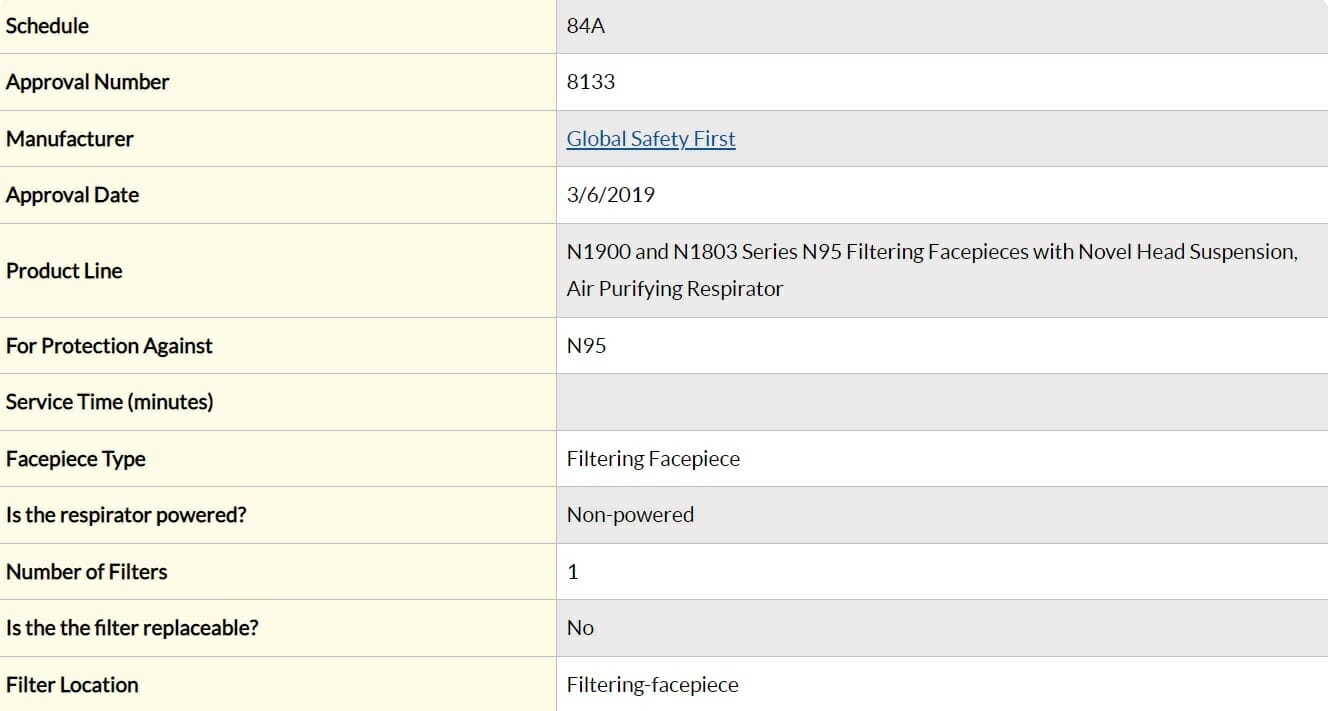
An image of the certification from my original review in 2023.
I talked with the CEO of ReadiMask and was informed that the withdrawal was a business decision rather than a performance one. Keeping a NIOSH approval active means annual fees and yearly onsite audits, and with roughly 90% of ReadiMask buyers being ordinary consumers rather than workplaces, the company decided the cost no longer made sense. It announced the change in a note to its customers, and says it intends to reinstate the approval before its next production run.
NIOSH itself puts the consequence bluntly: “Once an approval is voluntarily rescinded, the products that are labeled as NIOSH approved will no longer be recognized as approved and cannot be used in occupational settings where NIOSH approved respirators are required to be used.” In plain terms, if your employer requires a NIOSH-approved respirator, the ReadiMask no longer qualifies. If you wear one by choice, as most buyers do, nothing about the mask itself has changed.
Global Safety First also states that every mask it currently ships was manufactured while the approval was active, using the same materials and processes, and that it verifies fit and seal performance quarterly on a PortaCount 8048. However, please keep in mind that these are the company’s own checks rather than independent third-party ones.
Global Safety First is also quite transparent regarding the performance of the ReadiMask. If you visit its resources page, you will be able to find the original NIOSH testing report and approval letter alongside some other resources. Of course, these are records from when the approval was active rather than proof of a current one, but since the mask itself is unchanged, we can still look at the results.
Being a previously approved N95, the mask had to have ≥ 95% filtration per the NIOSH particle filtration efficiency standard (TEB-APR-STP-0059). This is one of the most challenging PFE (particle filtration efficiency) testing standards and shows the mask can provide a high level of filtration.
It’s worth noting two things at this point – first, although N95s are only required to have ≥ 95% filtration efficiency, most N95 respirators offer significantly higher filtration. When NIOSH tested the ReadiMask, the maximum leakage percentage witnessed was 0.549%, indicating a > 99.4% filtration efficiency. This was the worst-case result across 20 samples.
Back in 2010, TestSafe Australia also tested the ReadiMask family (the adult, child and half-mask versions) to AS/NZS 1716:2003 and passed all three as Class P2 respirators (report 32563). I mention this because of what it says about the track record of ReadiMask – this design has been passing respirator standards for more than fifteen years.
Although the NIOSH testing is both the most thorough and most important, other third-party testing can help support the performance claims of a mask or respirator. When Lloyd Armbrust tested ReadiMask (unfortunately, I can no longer link to this result as the page is now a 404), it provided 97.42% filtration. While not as high as the NIOSH results, this is still substantially over the required 95%.
AccuMed and Aaron Collins (Mask Nerd) also did filtration testing – AccuMed on the filter media alone, and Aaron with the ReadiMask being worn. Both results showed > 98% filtration. These results show the ReadiMask is more than capable when it comes filtration, and the difference in these results mostly comes down to fit.
At this point, some people may compare the ReadiMask to other masks that seemingly provide similar or higher filtration. For example, some masks, such as Cambridge Mask, claim to provide > 99% PFE. While this isn’t wrong, they use an entirely different testing methodology (ASTM F2299) which is far less demanding.
It’s been shown in multiple studies that NIOSH respirators tested as per ASTM F2299 (instead of TEB-APR-STP-0059) display significantly higher filtration results. For this reason, filtration results from these two standards (and others) shouldn’t be directly compared. At the end of the day, I trust the historical NIOSH data here most, and it was generated while the certification was active.

BreatheSafeAir is a one-person publication. Every share and every subscriber is important to me.
I don’t have a marketing budget or a team behind me. Just a lot of test equipment and a genuine interest in helping you make sense of your air quality. If you find this useful, subscribing to my newsletter is the best free way to support the work. You’ll get information on what I’m currently testing, findings that don’t make it into the full reviews, and the kind of detail you only get from someone who thoroughly tests these devices.
Fit


Before discussing the fit of the ReadiMask, I have to make a disclaimer: this mask will fit everyone differently, and the thoughts shared in this section are based purely on my experiences (and my wife’s). I can’t know if the mask will or will not fit you.
According to the NIOSH Bivariate Panel, I am a cell 5 (face length 11cm and width 15cm). This is considered a ‘medium’ cell and includes around 7% of the American population. I found the larger ReadiMask size significantly too large for me, and I settled on the small size- as I will discuss soon, it fits me very well.
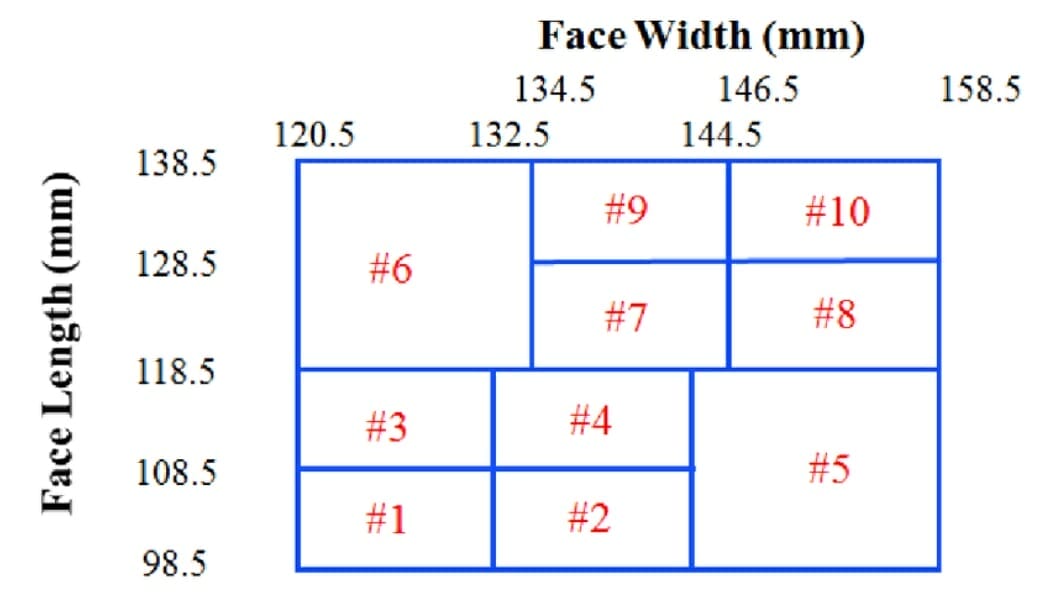
NIOSH Bivariate Panel for conformity assessment. Source.
If you fit into one of the first five cells, you will likely want the small masks too. Cells 6 and above should look at the large size. The range used to include an extra large (seen in the image below), but the masks are now sold in two sizes, Small/Petite and Large.
It’s worth noting that ReadiMask states the small size can also fit children along with adults with smaller faces. For most adults, the large size (which is really a medium) is likely to be the best fit.
With the small ReadiMasks, I experienced one of the best fits I’ve found with a disposable mask. As with many people, the 3M Aura is my usual go-to N95, and previously I found it to be the best-fitting mask. This was closely followed by the Honeywell DC365N95 – a surgical N95 that fits me well.
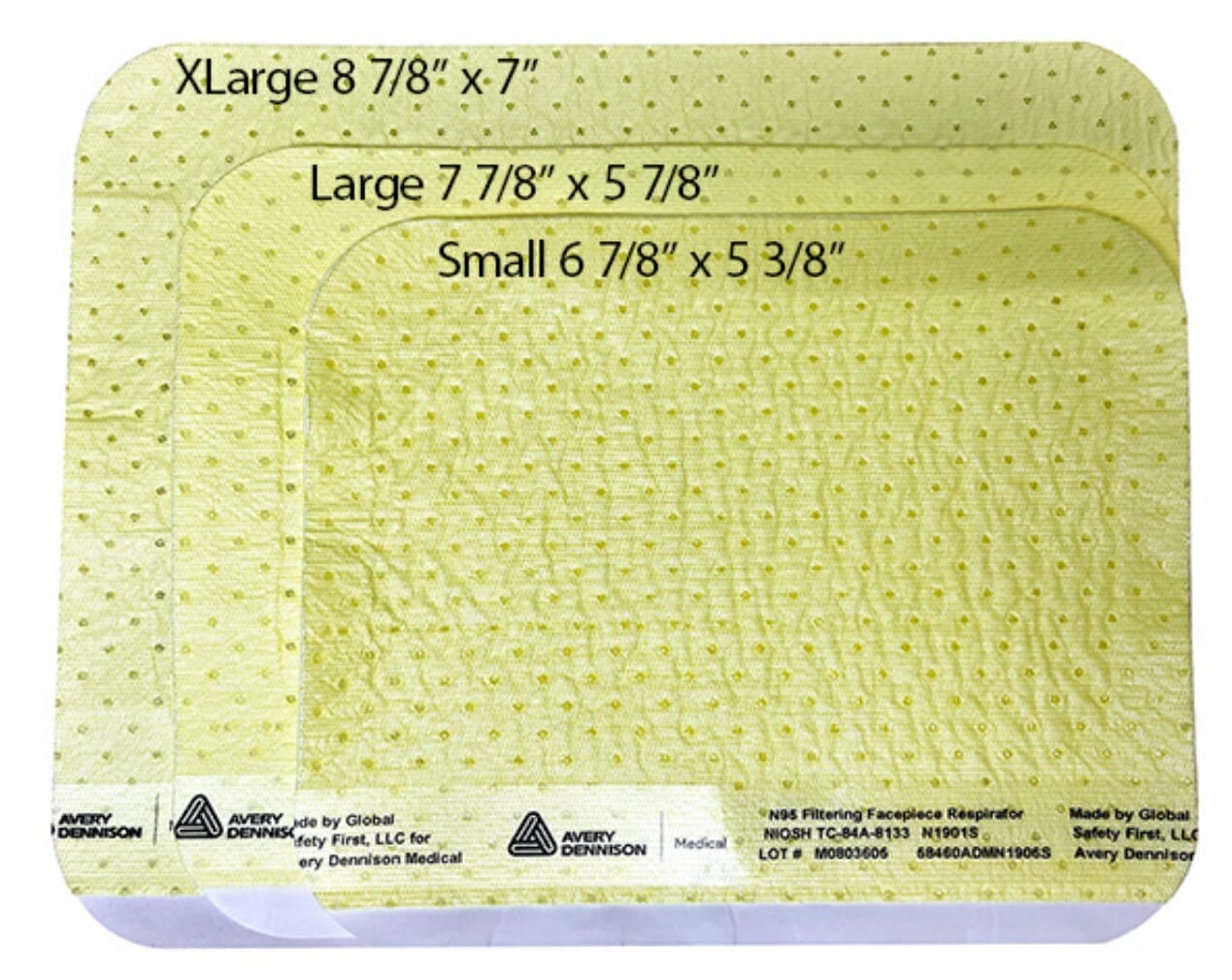
Please note the XL size is no longer available.
However, after trying the ReadiMask, it is equal to or better than these two masks in most situations. It fits me incredibly well, and I don’t notice any leaks when sealed. I don’t have the equipment to perform a quantitative fit test, but I had great results in a qualitative fit test – very similar to what I received with the Aura.
My wife has quickly become a fan of ReadiMask, too. She has a lower nose bridge and a smaller face than most masks are designed for, something she shares with many other East Asian women, and finding a mask that seals on her face has been a running frustration. She’s tried a lot of them – Zimi, IQAir, and plenty more.
The closest runner-up was the CanadaMasq Q100 in small, which fits her well. However, the ReadiMask is the one she usually reaches for, because the adhesive seals where nosepieces and earloops usually don’t on her face. There is no wire to bend and no gap beside the nose – the seal follows her face. If you (or someone in your family) have never found a mask that truly fits, ReadiMask is worth a look.

With this being said, the ReadiMask can be challenging to fit properly sometimes, and I experience leaks if the bottom of the mask isn’t sealed properly. There is a seam along the bottom of the mask once it’s fitted, and the point where this seam seals under my jaw is the most leak-prone part of the product
This is contrary to most masks & respirators, where the point most prone to leak is around the bridge of my nose, where the wire nosepiece is located. However, with the ReadiMask, I never had issues with leaking around my nose; instead, I found the bottom of the mask most prone to leaks.
This leak was preventable, but it can sometimes take a couple of adjustments or even a complete refitting to get the mask properly fitted and sealed to the underside of my jaw. Luckily, I had no situation where I couldn’t remove the leaks after a few adjustments. Once adjusted correctly, the mask sealed very well. Of course, once you get used to donning the mask, this becomes less and less of an issue.
Most impressively, I found the mask to stay sealed even when I talked, yawned, or coughed. When yawning, I could feel the adhesive pulling (which I discuss in the comfort section of this article), but the seal never broke. In fact, it handled these situations much better than a typical headband N95.
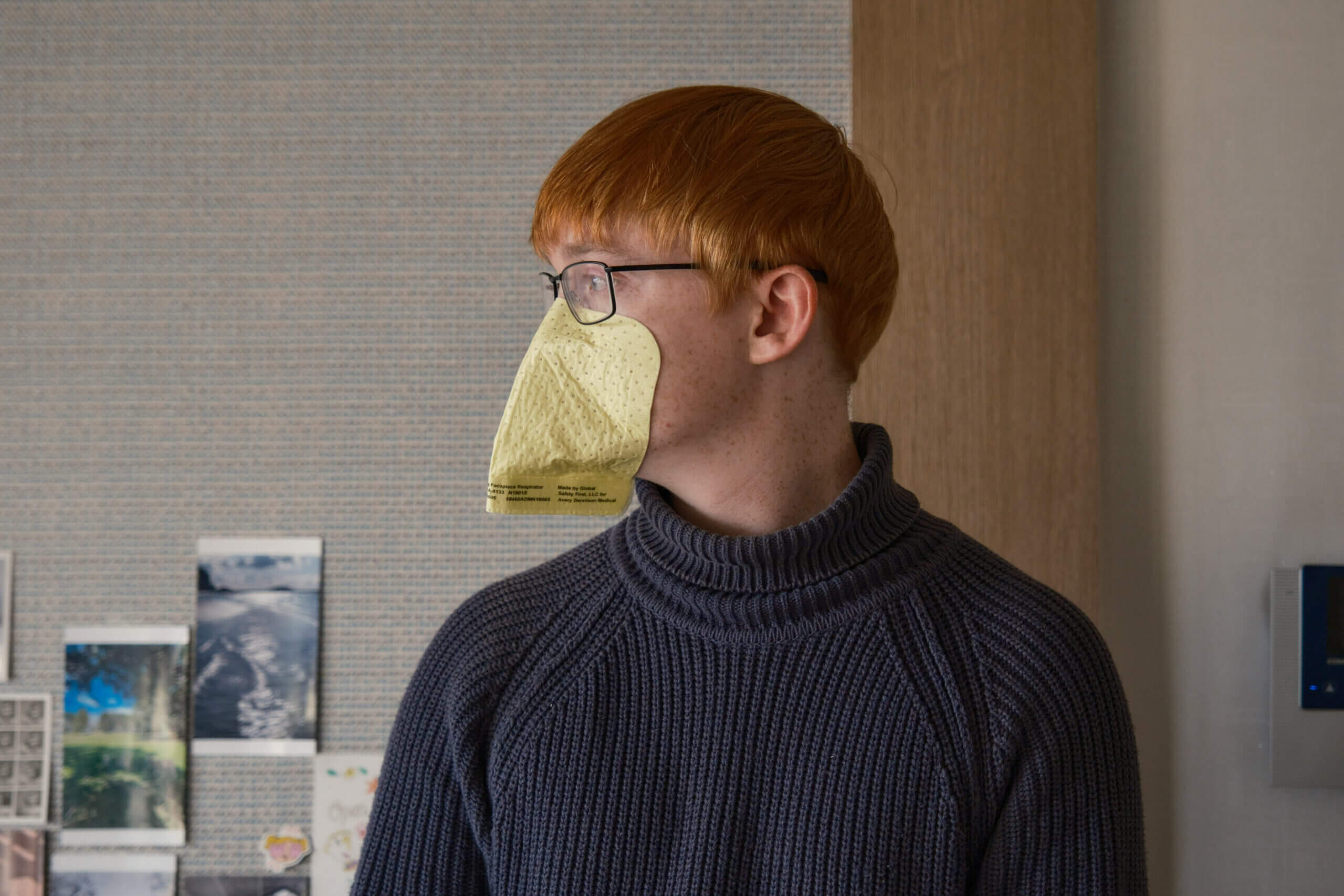
To make sure the ReadiMask remains sealed even during large mouth movements, you will want to have followed the fitting guide included with the masks. Although it’s natural to try and fit the product with your mouth closed, it’s far better to fit it with your mouth open (as the instructions detail).
This will leave the mask sealed with enough room to let you cough, yawn, or talk if needed. If you fit the product with your mouth closed, it can be very strained when you make large mouth movements, and the seal may break.
Interestingly, I also found the ReadiMask far less prone to becoming dislodged during day-to-day life. Since the mask is stuck to my face rather than mounted with headbands or earloops, I never had the seal break when looking left, right, up or down – something which can happen with other masks & respirators.
The fit also didn’t seem impacted by sweat. I was worried that the mask might gradually loosen on hot days due to sweat, but this didn’t appear to be an issue. While I made sure to fit the mask when my face was dry, I could sweat after donning the mask with no issue. Naturally, the adhesive will weaken over time, but I only found this to be an issue if I was re-using a mask.
You can probably already guess my conclusion for this section, but here it is anyway: after four years of on-and-off wear, the ReadiMask remains the best-fitting disposable masks I’ve tried, ahead of the Aura and the Honeywell DC365N95 I normally wear. And in our house, it’s the only mask that has ever properly fitted both of us.
Remember to watch the instructions and keep your mouth ajar when fitting the mask. Without this step, it’s easy to feel like the ReadiMask restricts talking and other mouth movements. However, with this extra step, I never felt restricted.
Comfort
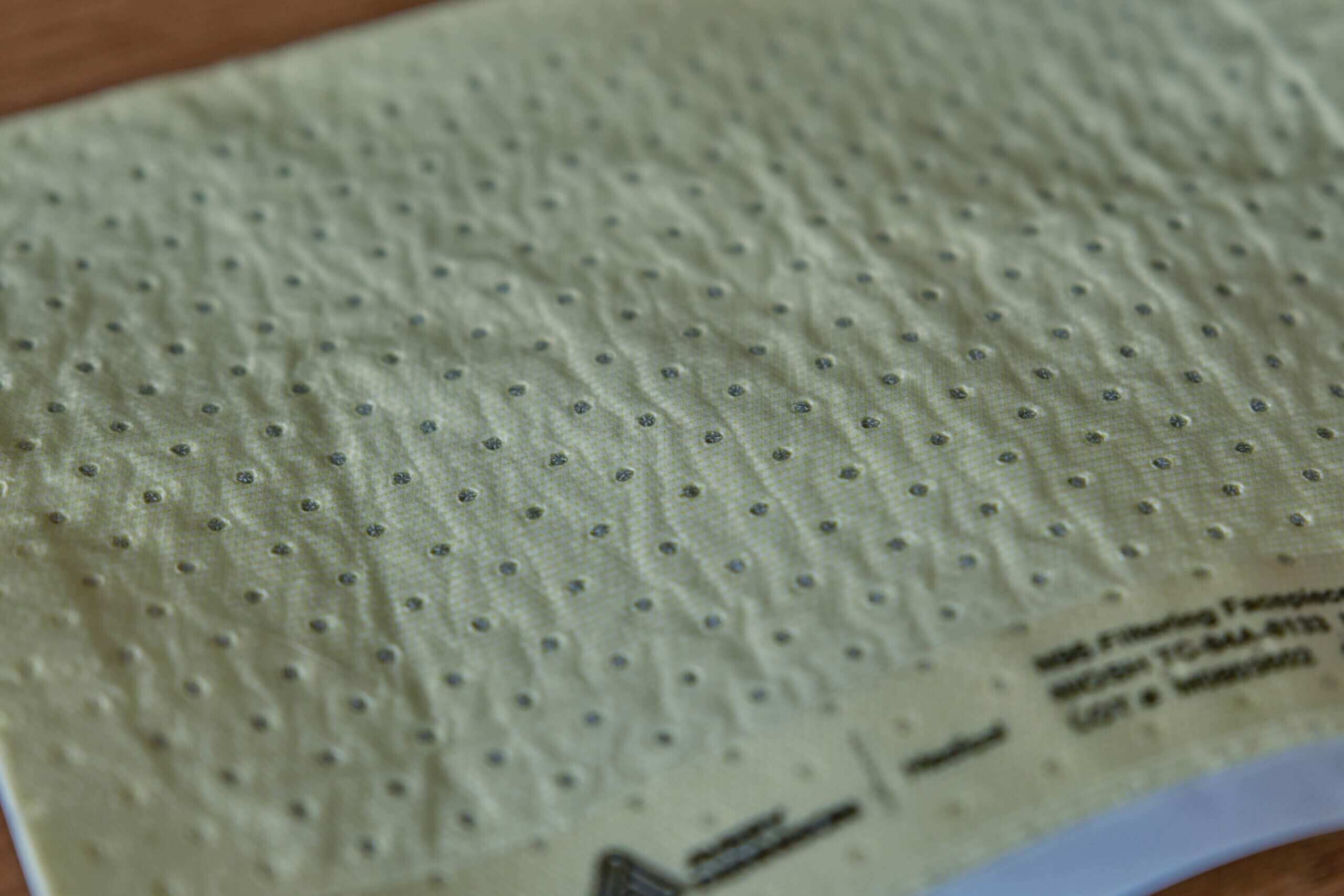
The ReadiMask was designed to combat one issue – the discomfort caused by most respirators. As someone who masks regularly and has tried well over 100 disposable masks and respirators, I feel I have a wealth of experience to base my thoughts on.
Since the ReadiMask was built as an N95, comparing it to other similarly-classed devices feels most relevant. Generally speaking, I find N95s the most comfortable respirator class. Headbands are required (as opposed to the earloops often found on KN95, KF94, and FFP2 masks), making them generally more comfortable. However, I still find that head loops cause discomfort and sometimes even pain after wearing them for a few hours.
On top of this, N95s tend to be less breathable than masks focused more towards consumers such as KF94s. Therefore, while many N95s tend to be comfortable (in my opinion), there is still significant room for improvement.
The ReadiMask is a vast improvement. Frankly, I was amazed at how convenient the mask is to wear and how comfortable it remains – even during long flights and train rides. Four years later, that hasn’t changed.
Since the mask isn’t fitted with headbands or earloops, there is no need to worry about the pressure these masks place on the back of your ears or head. While the feeling of the adhesive seal is initially unusual (and takes some time to get used to), I prefer this experience to wearing headbands or earloops.
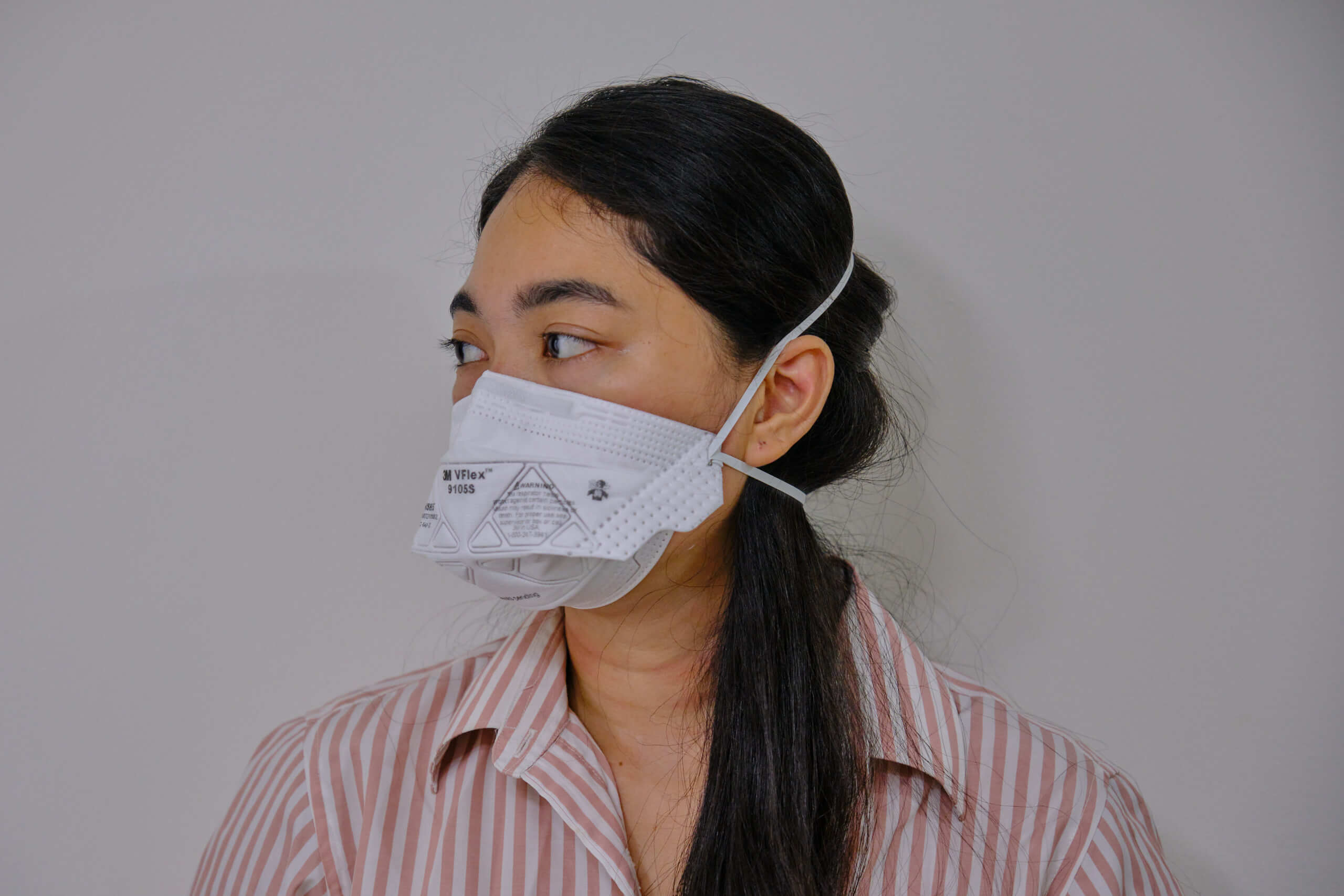
Any headband mask will interfere with hair and can quickly become frustrating.
There’s another comfort advantage I completely missed in my original review, and it took my wife to point it out: hair. Earloop masks tend to compromise on fit, and headband masks pull through and flatten whatever they’re stretched over. The ReadiMask touches neither. For her, that’s the second reason it wins – a proper seal without wrecking her hair – and I suspect many women will be in the same boat.
This unique sealing mechanism also has another bonus. My wife got a haircut just this week, and a haircut is about the worst case for a normal mask because they interfere with the areas the hairdresser needs to alter. However, ReadiMask is the perfect mask in these cases, because she could wear it without ever worrying about the seal.
That also brings me to an interesting point – MRIs. It’s generally impossible to mask during an MRI scan since nearly all masks and respirators use metal somewhere in their construction (usually in the wire nosepiece). However, since ReadiMask doesn’t use metal at all, this mask can be used during MRIs (but confirm with your hospital first). Currently, a third-party MR safety evaluation under ASTM F2503 is in progress, and I will update this review once it is. Please also note that this does not apply to the eye-shield variant of the mask.
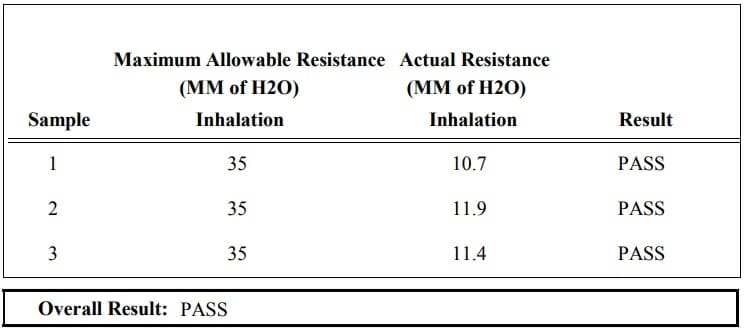
Inhalation resistance. From ReadiMask instructions page.
Breathability with the ReadiMask is good but not great. In NIOSH testing, inhalation resistance was between 10.7 and 11.9mmH2O. This puts it squarely in the middle of the pack regarding N95 inhalation resistance. Some respirators, such as the 3M 1860, 1870, and Gerson, have < 10mmH2O of inhalation resistance.
Exhalation resistance is lower, making the ReadiMask one of the better-performing masks of its class for exhalation resistance. Below you can see the results from the official NIOSH testing.
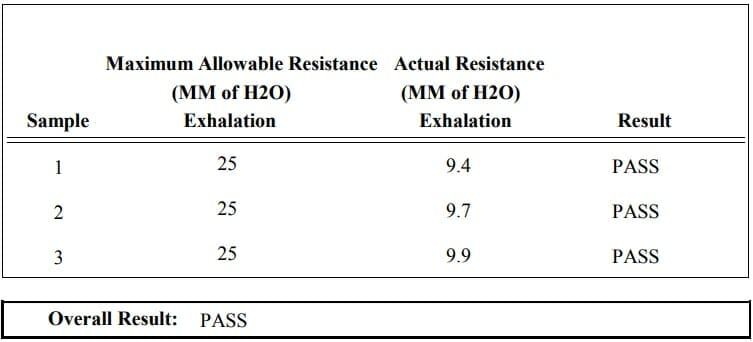
Exhalation resistance.
Lloyd Armbrust from Armbrust USA (again, link no longer active) did further testing on the masks and found them to have a pressure drop of 0.1024 kPa. Converted to mmH2O, this is 10.2mmH2O – better breathability than shown in the NIOSH results. However, my conclusion here stays the same – breathability is acceptable and comfortable but not the best.
While it’s not as breathable as some high-filtration masks, it’s more than breathable, and I experienced no discomfort related to breathing resistance. Combined with the lack of straps, this pressure drop result means the ReadiMask is a comfortable mask.

Another big advantage of the ReadiMask is the lack of ‘mask face’ after doffing the respirator. With most respirators – especially when you wear them tightly to get the best seal – it’s common to have red marks indented on your face for as long as 30 minutes after removing the device. With the ReadiMask, this issue is non-existent.
With the good points out of the way, let’s discuss the two downsides I’ve discovered in regard to comfort. These are not deal-breakers for me and don’t bother me much. However, these issues might be a big deal for some people, and it’s worth mentioning them.
The first is the filter collapse. Since the mask is super lightweight and is made from a thin material with no reinforcement, the mask has significant filter collapse. When I inhale, I often find the mask pulling towards my nostrils and regularly touching my nose. If I open my mouth and breathe, the mask will pull in and contact my lips when I inhale.
For this reason, I would not wear the ReadiMask for exercising or any high-intensity activity. It works best at normal breathing rates and interferes minimally in these situations. During exercise, it regularly gets in the way and becomes frustrating.
The filter collapse is also very visible to others. Although this doesn’t bother me, some readers have stated they feel self-conscious wearing the ReadiMask. If you feel this might be an issue, it’s worth avoiding this mask.
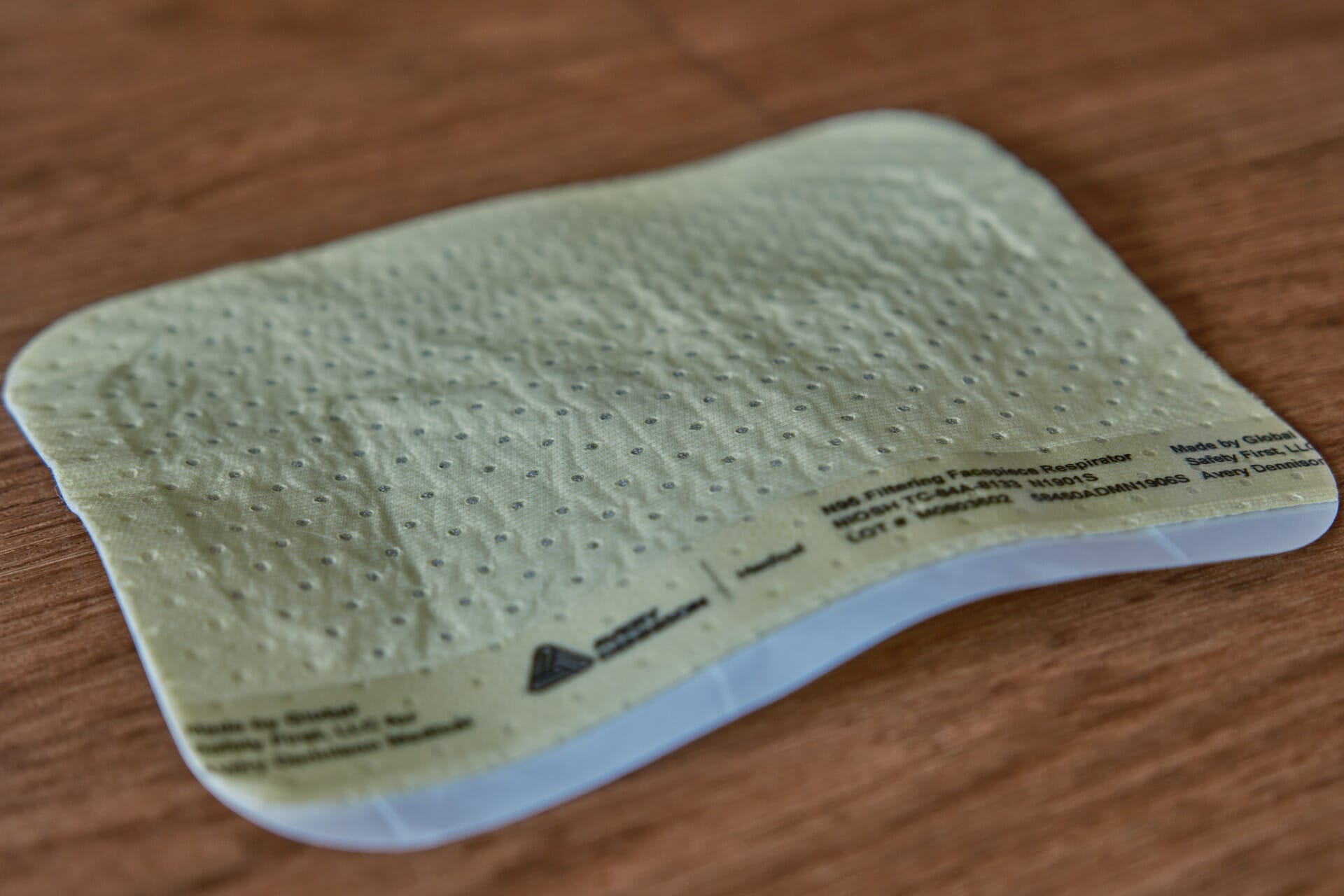
The mask is very thin and lightweight and suffers from filter collapse.
Secondly, the mask is slightly uncomfortable if you need to yawn, cough, or otherwise open your mouth wide. Even if you fit the mask with your mouth slightly open (as is recommended), the adhesive will pull on your face if you need to yawn or cough. However, this is the trade-off for a good fit, so I can overlook this.
Of course, I must mention doffing the mask, too, as you must pull the adhesive off your face. As someone who is clean-shaven, removing the mask wasn’t painful. It’s far more comfortable than removing a bandaid and didn’t pull any hair out. While I imagine this would be more painful for anyone with facial hair, you won’t want to wear this mask with facial hair anyway, as it won’t seal well.
Overall, the ReadiMask is a very comfortable mask. There are some minor discomforts, but on the whole, I believe this mask is the most comfortable disposable mask I’ve tried to date. I can happily wear this for long periods, such as during flights or train trips.
The Eye Shield Version

Since my original review, Global Safety First has released a version that I want to cover separately: the ReadiMask with Eye Shield. It’s the same adhesive-sealed mask, but it also has a clear shield that extends up to cover your eyes, sealing the lot as one unit.
When I first heard about this version, I was doubtful. Face shields attached to masks usually mean fog, glare, and a seal that’s worse, not better. I’ve now used it a few times, and it’s fair to say that it’s won me over.
This is no kind of formal testing, but I test air purifiers by burning incense in a sealed room, sometimes pushing PM2.5 to 2,000 µg/m³ while the incense burns. At those concentrations, my eyes water and burn within moments of entering the room – a normal mask does nothing for that. With the Eye Shield version of ReadiMask, I was able to enter the room without issue. No breathing discomfort, and for the first time, no watering eyes.
Admittedly, it’s a niche use, but it does have some applications: smoke, dust, allergens, and anything else that goes for your eyes as well as your lungs. If you’ve ever worn a respirator during wildfire season and still spent the day blinking, you’ll understand the point of this product immediately.
It’s important to note that the Eye Shield version is also not currently N95. It’s certified to ANSI/ISEA Z87.62-2021 as a Category 3 protector for the eyes, nose and mouth (verified by ICS Labs), and it passed anti-fog testing at over 45 seconds against an 8-second requirement. The company states it uses the same filter media as the base ReadiMask, but this one has never held an N95 certification.
Interestingly, the LA County Sheriff’s Department ran a real-life test against pepper spray and tear gas, and you can watch that test yourself. All I can say is that it’s a testament to the fit this mask can provide if they’re willing to step into a chamber with those gases!
The Eye Shield is currently sold as singles at $5.99 (Small/Child) and $6.99 (Large) rather than in packs. As far as I know, nothing else on the market combines a sealing mask and sealed eye protection in one disposable unit, so there isn’t really anything to compare it against. If the eye protection matters to you, this is the option; if it doesn’t, the standard mask is cheaper.
One more note before we move on: The sizing with the eye shield version of the mask is slightly different, and both my wife and I found ourselves using the large mask as opposed to the small (we both wear the small standard ReadiMask).
Pricing & Reuse

ReadiMask is sold in 10-packs at $39.90, which works out to $3.99 per mask. The 25% discount code ‘BreatheSafeAir25’ brings a pack to $29.93, or just under $3 per mask, and the code is tracked to this site, so using it supports my testing at no extra cost to you.
There are monthly, bi-monthly and quarterly subscription plans that allow you to save up to 40% on the price. This brings the cost down to just under $24 for a 10-pack, or about $2.40 per mask. Oh, also worth noting is that each 10-pack comes with one additional mask, folded and zip-locked so you can carry it with you, ready to be used.
At $3-4 each (assuming a one-off purchase), the ReadiMask costs significantly more than other premium masks like the Aura 9205 (other models like the 9210+ are more costly). However, at $2.40 or less, they’re far more comparable – at least if you are only comparing cost per mask.
The bigger issue with the pricing of the ReadiMask is, of course, reuse. Depending on their treatment, other N95-class respirators can be reused for many days (especially if you’re using them to protect from PM2.5), whereas the adhesive seal on the ReadiMask means it has a far more limited lifespan.
Officially, the ReadiMask should not be reused. However, this is similar across all disposable masks & respirators, and research shows they can generally be used for longer than their intended lifespan. With that said, it’s a different matter with the ReadiMask.
I found the adhesive seal was usually strong enough for two full uses (two days of wear), and on the third day, the seal began to lose a substantial amount of stickiness. While I could wear it for a third time, it was not ideal, and I would recommend changing the masks more regularly than every third day.
I also tried to remove the product as infrequently as possible. Every donning and doffing of the mask will cause more wear on the adhesive, and if possible, you’ll want to avoid doffing ReadiMask unless necessary.
At $3.99 per wear (realistically $2 per day across two wears – again, assuming you don’t subscribe), this is not an everyday mask unless money is not a big concern. It’s also worth knowing that if you’re outside the US, sourcing can be a pain – I’m in the Philippines, and getting these masks here is neither quick nor cheap. That’s part of why I don’t wear them daily myself.
So where does the ReadiMask make sense? In exactly the situations where nothing else works. Getting a haircut? Nothing else works. A long-haul flight where headbands dig in after hour three? This is the most comfortable option I’ve found. An MRI? One of the only options. My wife’s face, which no wire nosepiece has sealed against? ReadiMask.
On my flight from Singapore to Korea (about 7 hours), I wore an Aura, and after a few hours, it really bothered me. The head straps – while much better than earloops – aren’t comfortable for me after such a long period. Following that, I chose the ReadiMask for another long flight I took a few weeks later, and I never regretted it once.
This leads me to conclude that with the price and limited reusability, the ReadiMask isn’t an everyday respirator. That said, it’s a fantastic one to have on hand, because when it’s the right tool, it’s usually the only tool. I would happily pay the premium in these situations, and after four years, I still keep a pack in the drawer.
I’m also usually very against subscriptions, but I think this might actually be one worth considering. As I said, I don’t think this is an everyday mask. However, having a few on hand (especially as one comes folded in a zip-lock bag ready for use) is extremely handy for those situations where you don’t expect to need a mask and then suddenly do.
Conclusion
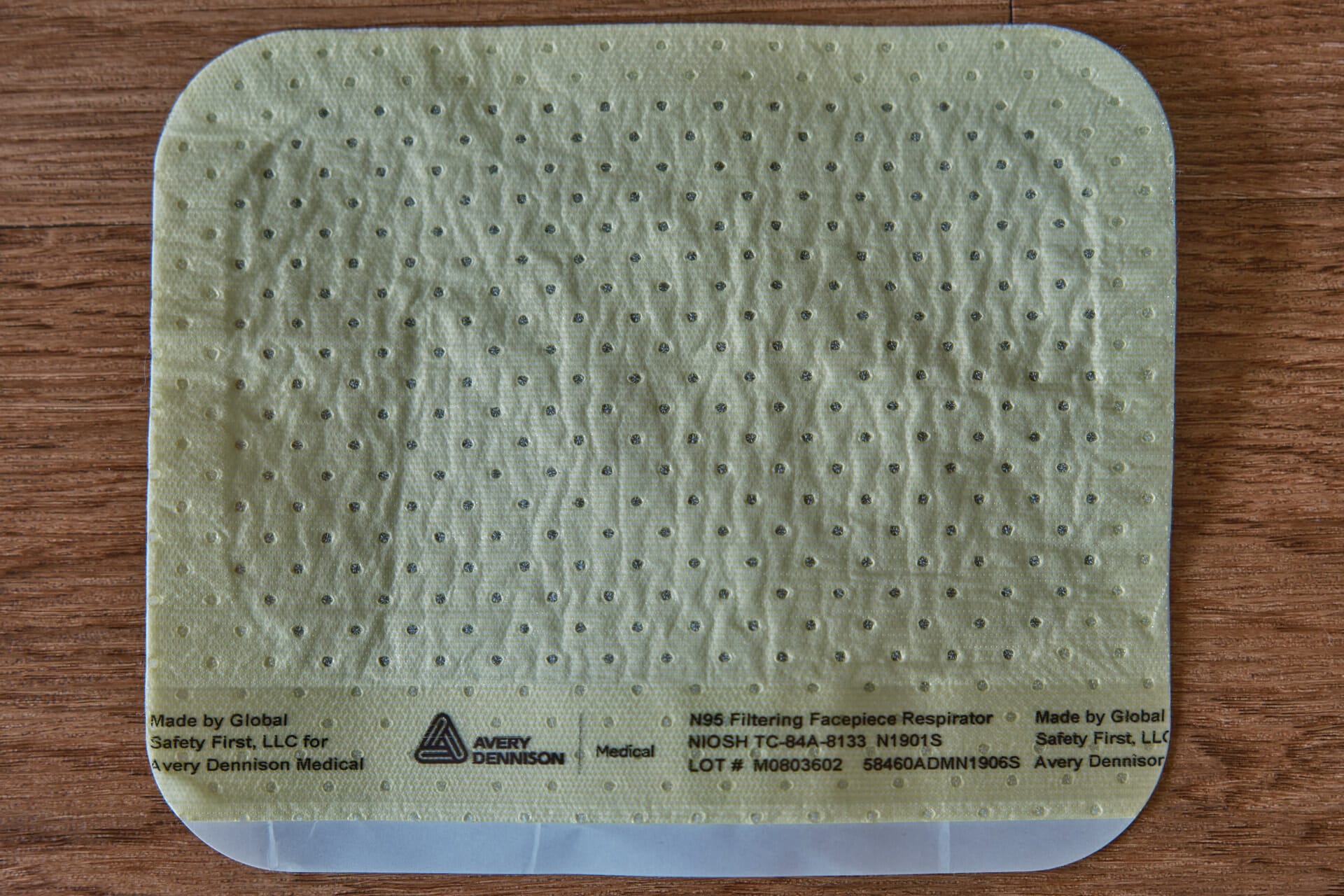
Almost four years ago, I ended this review by calling the ReadiMask one of the best-fitting masks I’d tried. I’ve worn a lot of masks since, and that conclusion hasn’t changed. What has changed, however, is everything around the mask, so let me give you the updated picture.
The certification situation is the big one. The ReadiMask is no longer a NIOSH-approved N95 – the approval was voluntarily withdrawn in March 2025 for business reasons, with the intent to reinstate it with the next production run. The mask is unchanged, and the historical test data (worst-case leakage of 0.549% across 20 NIOSH samples) was real testing on this design. If your workplace requires a NIOSH-approved respirator, this can’t be it right now. For everyone else, the mask protects exactly as it did.
The fit remains the reason to buy it. It seals better on my face than the 3M Aura and Honeywell DC365N95, and it stays sealed through talking, yawning and looking around in a way headband masks don’t. More telling, it’s the only mask that has ever properly fitted my wife, whose lower nose bridge and smaller face have defeated everything else she’s tried. For anyone in that position, this mask isn’t just innovative – it might be the only option that actually works.
It’s also the most comfortable disposable mask I’ve used, and the only one that leaves hair alone, which matters more than reviewers like me tend to notice. The Eye Shield version extends all of this to your eyes, and having stood in a room at 2,000 µg/m³ of incense smoke without blinking, I’m now a believer in that version too.
The price is the catch. At $3.99 per mask ($3 with the code and $2.40 with the subscription), single-figure reuses, and awkward sourcing outside the US, this is not a daily driver for most people. It’s a specialist. Buy a pack, keep it for the haircuts, the long flights, the MRIs, the smoky days, and the faces nothing else fits, and it will earn its place. It’s also such an easy product to fold and store in a handbag, backpack, or even satchel, ready for emergencies. However, it’s a bit costly for an everyday mask unless it’s your only option.
Have you tried the ReadiMask, or does someone in your house have the same fit struggles my wife does? Please share your experiences in the comments below – I would love to hear from you, and I’ll help with any questions whenever possible!
ReadiMask FAQ
Is the ReadiMask Niosh Approved?
Not currently. The mask was manufactured and tested under NIOSH approval TC-84A-8133 while it was active, but Global Safety First voluntarily withdrew the approval in March 2025 for business reasons. The mask itself is unchanged, and the company intends to reinstate the approval with its next production run.
How Does the ReadiMask Seal?
The ReadiMask uses a skin-friendly adhesive to seal on the wearer’s face.
Can I Reuse the ReadiMask?
While most masks & respirators are only rated for single use, the mask can often be reused 2-3 times if needed.
Does Sweat Interfere With the ReadiMask Seal?
No – although it can make donning harder. If you don the mask with a dry face and sweat once the mask is donned, there is no issue with the seal.
Can I Wear the ReadiMask With Sunblock?
Yes. I had no issue wearing the respirator with sunblock.
Does It Hurt to Take off the ReadiMask?
No – the feeling is less painful than taking off a band-aid. I found no hair stuck to the adhesive on the mask after I doffed it.
Is the ReadiMask Comfortable?
I found it more comfortable than most other N95s (and N95-equivalents). I would say it’s one of the most comfortable masks/respirators I’ve tried!
How Can I Fit the ReadiMask?
Global Safety First provides a fantastic guide here.
Does the ReadiMask come with eye protection?
Yes. The ReadiMask with Eye Shield adds a sealed clear shield over the eyes. It is not an N95; it is certified to ANSI/ISEA Z87.62-2021 as a Category 3 protector for the eyes, nose and mouth, and sells as singles at $5.99-6.99.
Is the ReadiMask MRI safe?
Yes. Both versions are metal-free, and Global Safety First publishes an MRI-safe statement you can show at an appointment. It is one of very few respirators with no nose wire.