

Smart home gadgets have crept into pretty much every corner of the house (at least they have in mine!), but, until recently, smoke alarms have remained stuck in the past. Most are still standalone devices that beep far too early in the morning with no way to silence them from your phone and no link to anything else you’ve got running. Perhaps that makes sense for such a safety-critical device, but it doesn’t change the fact that when I heard about the Sensereo MS-1, billed as the first Matter (over Thread) smoke alarm on the market, I had to take a closer look.
If you’re unaware of Matter, it essentially means the MS-1 integrates into Apple Home, Alexa (which is what I run), Home Assistant, Google Home, or any other smart home system that supports the standard, and isn’t tied to any one ecosystem at a time. My smart home is a bit crowded at this point, so I’ve grown to appreciate the Matter protocol for how effortlessly it integrates new devices into a setup. This is especially true when it comes to Matter over Thread devices which bypass Wi-Fi entirely.
However, none of this connectivity matters (that pun was totally unintentional, I swear) if the alarm can’t do the one job it exists for. So certification is where I always start with any smoke alarm. The MS-1 is certified to the relevant European standard for residential smoke alarms, which I’ll cover properly in the next section. One important caveat upfront though: this is currently an EU-focused product. Sensereo has confirmed they’re working on a US-focused version too, but that isn’t here yet. Don’t use the MS-1 in a country where it isn’t certified. You’ll be running an alarm that hasn’t been tested against the test fires your local standard demands, and if there’s a fire, an insurer can decline a claim on the grounds of non-compliance with local safety code.
Anyway, on paper, the MS-1 looks promising on the two aspects that matter most to me: the safety credentials and the smart home integration. However, what I want to find out is how these translate to real life. A spec sheet can promise Matter compatibility and an independent certification, but it can’t tell you whether the alarm pairs the first time, or whether the app fades into the background after a couple of weeks (which is exactly what you want from a smoke alarm). And the bigger question: is a Matter-enabled smoke alarm even useful, or worth the price premium? Let’s find out.

I independently review air quality monitors with a focus on accuracy. I’ve tested well over 50 devices, compared some of them against reference instruments, and rely on peer-reviewed research and third-party studies wherever possible.
I don’t accept sponsored posts or paid reviews, and I don’t run ads on BreatheSafeAir. When I receive a free product, the company has no say in what I write. Affiliate links don’t influence my views and never increase the price you pay.
I’m constantly learning about how these sensors work – from opening them up, discussing with researchers in the field and examining the hardware inside. That ongoing learning process helps me write reviews that are grounded in how the technology actually behaves, not just what the spec sheet says.
You can read my full Disclaimers & Ethics page for complete details. And as with any review, even mine, I always encourage checking multiple independent sources before making a decision.
This post contains affiliate links. For more information, please refer to my affiliate disclaimer. I was sent a product for review, but the article is not sponsored. All opinions expressed in this post are my honest thoughts. I only recommend products that I genuinely believe in.
Informational Purposes: Information on this blog is for informational purposes only. Readers are encouraged to confirm the information herein with other sources. This website assumes no responsibility for the accuracy of the information, and information is subject to change without notice. Products mentioned on this website are not medical devices and do not guarantee protection.
If you notice any errors or inconsistencies in this article, please contact me so I can update the information accordingly.
Certification & Performance

The first thing I wanted to pin down was whether the MS-1 is a proper smoke alarm or a smart-home ‘toy’ with an alarm function bolted on. Thankfully, as it turns out, it’s an alarm first, with the smart features layered on top. The MS-1 holds EN 14604 certification from TUV Rheinland, and I was very happy to confirm this as I would never have even begun to write this review otherwise.
For those unaware, EN 14604 is the European standard for residential smoke alarm devices, published by CEN (the European Committee for Standardization). To pass, a smoke alarm has to clear a battery of tests covering smoke sensitivity using standardised test fires, audible output of at least 85dB at 3 metres (loud enough to wake you from a deep sleep), battery life, operating temperature from -10°C to +55°C, humidity tolerance, electromagnetic interference, and physical durability. It also has to include features like a low-battery warning and a “battery missing” indicator. CE marking for sale across the European Economic Area depends on passing EN 14604, and any legitimate smoke alarm sold in the EEA must carry it.
If you’re from North America, you may be more familiar with the UL 217 smoke alarm standard, and this is where it gets interesting. While EN 14604 is a solid baseline, UL 217 (the US residential smoke alarm standard) is widely considered stricter – especially with the more recent updates. The key difference is around nuisance-alarm resistance and fire discrimination.
UL 217 makes a smoke alarm prove it can tell the difference between cooking smoke (specifically, smoke from frozen hamburger patties under broiler coils) and dangerous smoke from a flaming polyurethane foam pad. EN 14604 doesn’t push as hard on this front, so a device certified to EN 14604 won’t automatically pass UL 217 without further testing. I asked Sensereo about this directly and they told me they’re looking into UL 217 certification and want to bring the MS-1, or a US-spec variant of it, to the American market down the line. However, for now, the MS-1 isn’t certified to any US standard. If you’re shopping from the US, this isn’t the device for you yet. EEA residents (and those from other areas using the EN 14604 standard) are the intended audience for this generation of the product. Anyway, back to the device itself.
The MS-1 uses a photoelectric smoke sensor (as opposed to an ionisation sensor), which is the most common technology for residential alarms in Europe. Photoelectric sensors are better suited to smouldering fires, the kind responsible for most fire deaths since they tend to happen overnight when people are asleep. As for how long the unit will last you, Sensereo rates the MS-1 for seven years from installation, after which it needs swapping out. That’s a bit shorter than the 10-year figure NFPA recommends in the US, but it sits inside the normal range for the category. Most smoke alarms are good for somewhere between 7 and 10 years before their sensors start to lose sensitivity, and EU manufacturers tend to land on the more conservative end of that window. It’s also worth mentioning that the MS-1 has an end-of-life warning built in. Unfortunately, I won’t be able to test this feature for many more years.
I think a lot of people will be asking the question that I had in mind, so let’s answer it now. Yes, the MS-1 functions as a “dumb” alarm too. If your network drops out for whatever reason (and home networks often seem to find ways), the MS-1 keeps detecting smoke and alarms in the same way a basic battery-powered unit would. The smart features go quiet until things come back online, no push notifications, no app status, but the alarm itself will still function to the EN 14604 standard. For a safety-critical device, I would expect nothing less.
Admittedly, there isn’t much I can do to test a smoke alarm and I’m also not the right person to do so. However, I did have some questions that I wanted answers to, and that led to me conducting some testing. That brings up a topic worth briefly touching on.
A smoke alarm is not an air quality monitor
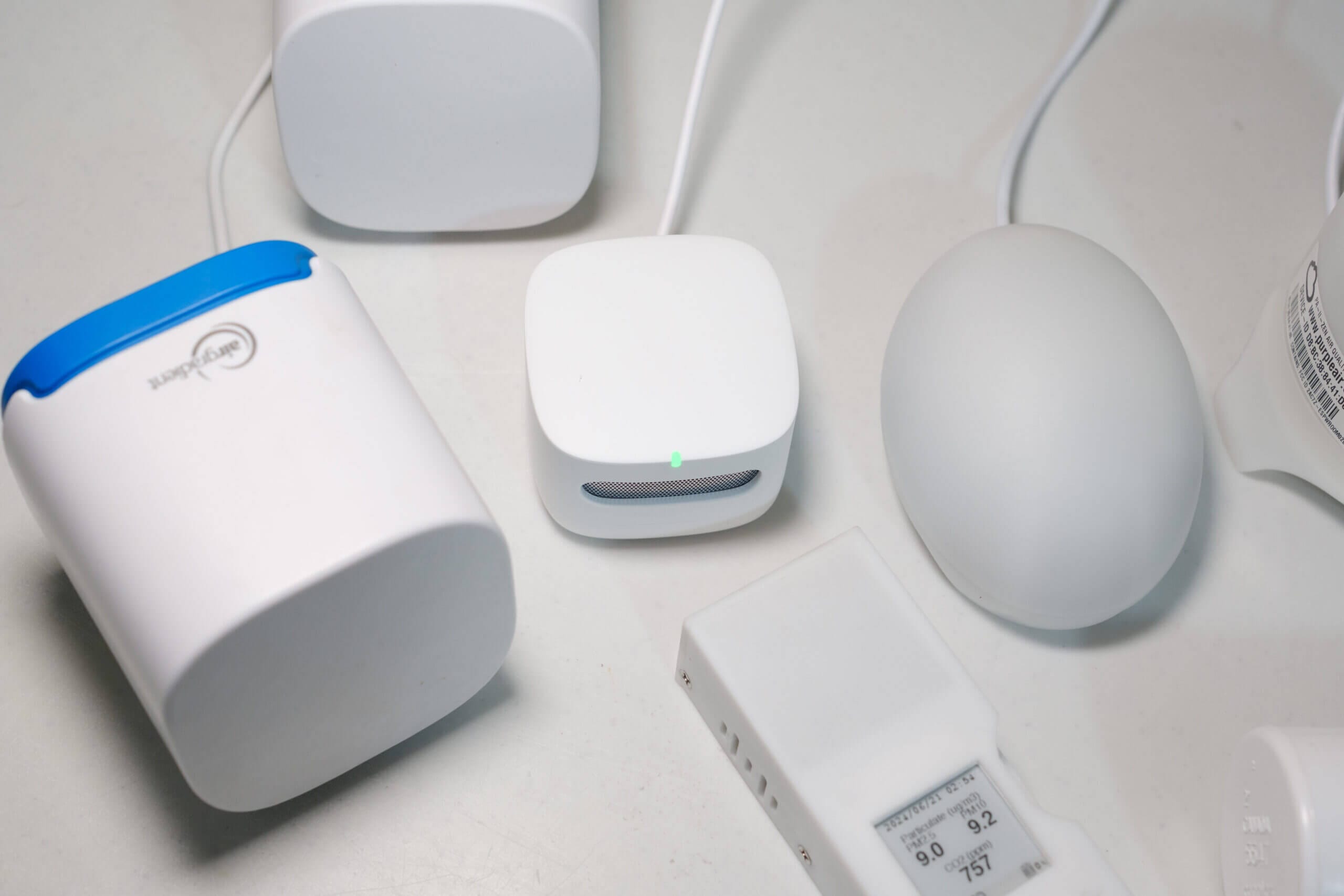
I know this may be obvious to some, but there are also times when people assume a smoke alarm doubles as an air quality monitor. It doesn’t – not even a smart one like the MS-1. A smoke alarm and a PM monitor look like they’re doing similar work, since both detect airborne particles, but they’re calibrated for entirely different jobs. A PM monitor (like a PurpleAir monitor) is tuned for relatively low concentrations of fine particulate that matter for long-term health, the kind of readings you might see during a high-pollution day or while cooking.
A smoke alarm, on the other hand, is tuned for the much higher particle concentrations that signal an actual fire. The exact activation threshold varies by alarm and isn’t expressed as a mass concentration in the EN 14604 standard (which uses optical obscuration measurements rather than μg/m³ or mg/m³) but a rough equivalent is somewhere in the range of 5 mg/m³, or about 5,000 μg/m³ in the units your air quality monitor uses. However, please treat that figure as illustrative rather than precise.
As an example, say I’m cooking something smoky and my air quality monitor jumps to 800 μg/m³ (a very high but not unheard-of concentration). That’s a hazardous reading by air quality standards and would have a PM2.5 sensor showing purple or maroon. Yet, it’s still about six times lower than what a smoke alarm needs to trigger. In this case, the MS-1 would sit there, completely indifferent to my dinner. Which is the point. If smoke alarms went off every time you fried some bacon, no one would have one in their kitchen or anywhere nearby.

AirGradient recorded almost 1000 μg/m³, but the MS-1 didn’t react at all. It wasn’t even considered ‘warning’ in the Alexa app.
While far from scientific, I was curious so I tested this in practice. I burned three incense sticks in a room with an AirGradient monitor running alongside the MS-1. The AirGradient peaked at just under 1,000 μg/m³ – a reading that would register as hazardous on any air quality scale – and the MS-1 didn’t make a sound. On another occasion, cooking pushed the AirGradient to 1,200 μg/m³ in the same room (don’t ask – image below), and again the alarm stayed quiet. While it sounds odd, that’s exactly what you want.
One of the frustrations with older ionisation alarms (which are more sensitive to the small, fast-moving particles that cooking and steam produce) is how easily they get triggered by using a bit too much oil. I’ve personally set off ionisation alarms cooking as far back as I can remember, and I can remember being scared of setting off the alarm while I was cooking as a teenager. Photoelectric alarms are less susceptible to that, and the MS-1 held up to that reputation in my testing.

Of course, this is all great news, but only if the device does actually audibly alarm you when there is real danger. To confirm it could actually do its job, I put the alarm on the ground outside, lit a small fire next to it, and covered both with a stainless steel container to contain the smoke. The MS-1 triggered in roughly 45 seconds. So yes, the MS-1 is a fire-detection device only. If you want to track indoor PM2.5, you still need a dedicated air quality monitor. However, as a fire-detection device, it does its job.
BreatheSafeAir is a one-person publication. Every share and every subscriber is important to me.
I don’t have a marketing budget or a team behind me. Just a lot of test equipment and a genuine interest in helping you make sense of your air quality. If you find this useful, subscribing to my newsletter is the best free way to support the work. You’ll get information on what I’m currently testing, findings that don’t make it into the full reviews, and the kind of detail you only get from someone who thoroughly tests these devices.
Functionality & Placement

MS-1 with mounting plate attached.
Out of the box, the MS-1 looks like a standard residential smoke alarm. It measures 110 x 110 x 41.6mm and weighs 165g, which is very similar to what’s already on most ceilings. To be honest, if you didn’t know this was a smart device, you would probably just assume it’s a normal smoke alarm. The kit includes a mounting bracket and screws.
On the back of the monitor you’ll find an on/off switch, a Matter pairing QR code, the Matter module itself (which slides out when you need to swap the replaceable battery), and the regulatory print. Venting is located around the sides so smoke can reach the sensor from any direction. The mount uses a twist-to-lock design, so getting the unit down again is just a matter of rotating it. The alarm itself is rated at 85dB or above at 3 metres, the EN 14604 minimum, which is loud enough to wake a sleeping adult through most closed doors.

Where you mount the MS-1 matters as much as which alarm you choose. A smart smoke alarm is still a smoke alarm, and installation comes down to the same basic best practices any fire safety guide will list. Sensereo’s own placement guidance is to mount the MS-1 on the ceiling, at least 0.5 metres away from any wall. If the ceiling is pitched, place the unit slightly below the apex (at most 600mm below the apex) rather than at the very top, because hot air pools at the peak and slows detection. For coverage, the general rule of thumb is one alarm per bedroom, with additional units covering each living area and hallway.
There’s a longer list of places to avoid. Skip anywhere near stove tops and damp rooms like bathrooms should be avoided too. Garages and workshops with heavy dust or vapours aren’t ideal either. Avoid the draught from fans or AC vents, because moving air can blow smoke past the sensor or starve it of smoke entirely. Windows can cause the same issue. And don’t put it anywhere the temperature climbs above 50°C or drops below 0°C, which may rule out some areas.

There’s a large button on the front face of the alarm that triggers a self-test when pressed. Sensereo recommends testing your alarms regularly (monthly is the standard advice), and the front button makes that a quick job. The red LED next to the button does double duty. It flashes occasionally to signal that the device is alive, and it also flashes when the alarm has detected smoke (or is tested) so you’ve got both an audible signal and a visual one when the device is reacting to something.
Hush mode is one of the features I appreciate most about the MS-1 – though it’s not exactly unique to this device. If the alarm goes off in a situation where you know there’s no real fire risk (you’ve blackened a piece of fish or the toast has taken a turn for the worse), you can press the Hush button to silence the buzzer for 8 to 10 minutes. While Hush is active, the red LED flashes every 45 seconds as a reminder that the alarm is still on standby. Press the button again and the device exits Hush mode straight away. It sounds like a small thing, but a smoke alarm without a Hush function is the kind of device you eventually disable in frustration, which defeats the whole point.

The MS-1 runs on two batteries that do different jobs. One is a sealed, non-replaceable cell that powers the core smoke detection, and it’s designed to last the full seven-year lifespan of the device. The other is a user-replaceable CR123A that powers the connectivity side – the Matter radio and the smart features. When the CR123A starts to run low, you’ll get a low-battery notification through your smart home platform. Even if you ignore that notification or you’re away from home for a stretch, the alarm itself keeps working off its built-in cell and continues to function as a basic dumb alarm.
The MS-1 is a smoke alarm and only a smoke alarm. If you also want carbon monoxide detection, Sensereo sells a separate model called the MSC-1 that covers both. For most rooms in a home, smoke-only is the right choice. However, anywhere with a fuel-burning appliance, gas boilers and wood stoves being the obvious examples, needs CO coverage as well.
Connectivity
The MS-1 connects to your smart home over Matter, running on Thread. If you already know how Matter works, you can skim past the next bit. For everyone else, the short version is this: Matter is a cross-platform smart home standard that lets devices from different brands work together across Apple Home, Google Home, Alexa, Home Assistant, and many other platforms. Thread is a low-power mesh network underneath that the MS-1 uses to talk to your home. The catch is that any Matter-over-Thread device needs a Thread border router somewhere on your network. That’s basically a hub that bridges Thread to your regular Wi-Fi so the rest of your smart home can see it.
The good news is that you might already own a Thread border router without even knowing it. A recent Apple TV 4K acts as a Thread border router on the Apple Home side. On the Amazon side, an Echo Show or an Echo Dot Max will do the same job. Some Google Nest devices and the newer Eero routers also count. If you don’t have anything Thread-capable already, you’ll need to add one before the MS-1 will pair.
Adding the MS-1 was about as quick as Matter setup gets. Put the device into connectivity mode, scan the Matter QR code on the back, and the pairing flow takes care of the rest. I had it in my system without any issues, and I tested it with Apple Home, Alexa, and Home Assistant. Matter is a breeze, because there is no proprietary app to install and no account to create. This is the part where Matter actually delivers on the promise it’s been making for the past few years (there are a few areas where it’s still a bit of a letdown – though that’s a qualm with the protocol itself, not with this device).

The device is very limited when combined with Alexa.
One of the better things about Matter is that you can expose a single device to more than one platform at the same time. In my case, the MS-1 lives in both Home Assistant and Alexa, so I can see its status from either side. Not every feature shows up on every platform though, and Home Assistant gives you the most by a wide margin. Alexa only surfaces three states: normal, warning, and severe. Home Assistant, on the other hand, exposes a lot more, including a remote alarm test, the current battery voltage and battery status, and the end-of-life timer for the seven-year sensor. So if you want full visibility into the device, HA is the place to do it.

Before going on, I want to ask (and answer) a fundamental question for this device: is smart connectivity actually useful for a smoke alarm? I think it’s a fair question. A smoke alarm isn’t an air quality monitor where you can tie readings to a fan or a purifier. Rather, the MS-1 reports a small handful of states, and the vast majority of the time it sits there quietly saying “normal.” So what does the smart side actually buy you? Here are a few things that came to my mind:
- Push notifications when you’re not home. This is the big one. If the alarm triggers while you’re at work or away on holiday, you can find out immediately what is happening and take action (such as calling the fire department) if needed.
- HVAC shutoff. If your heating, ventilation, or AC is running when smoke is detected, it’ll happily spread that smoke through the house and feed the fire with fresh oxygen. An automation that cuts HVAC power when any MS-1 alarms is a feature you’ll hopefully never need, but it could prove useful.
- All the alarms sounding together. With multiple MS-1s on your network, you can build an automation so that any one of them triggering makes the rest sound too. A smoke alarm in the basement that only beeps in the basement probably isn’t doing too much to wake people upstairs. You can also layer smart speakers on top of this to announce which room is alarming, which helps when you’re trying to work out whether to evacuate via the front or the back.
- Lights to full brightness. An automation that pushes every smart bulb in the house to 100% white when the alarm triggers makes evacuation easier early in the morning.
- It’s easy to test the device without the need to reach it. For me, this was the most useful feature because the ceilings in our living room are (at their highest) around 4 metres high and very hard to reach. Being able to test the device remotely has been quite helpful.
Of course, none of these turn the MS-1 into a different category of device. It’s still a smoke alarm at its core, and it’s a device that you hope you never need to actually use. With that said, there are some handy benefits to having a smart alarm and these are worth consideration.
Pricing and the alternatives

MS-1 and MSC-1 (with CO monitoring)
The MS-1 sits at around the $50 mark, with similar pricing in euros and pounds. A basic photoelectric smoke alarm certified to EN 14604 costs somewhere between £10 and £25 in the UK, depending on the brand and whether you’re buying singles or a multi-pack. You’re paying roughly two to four times more for the MS-1 over a no-frills certified alarm. Whether that’s worth it comes down to how much you value the Matter integration. If your smart home is built around alarms triggering automations and giving you remote visibility, the premium can be justified. If you just want something that beeps when there’s smoke, a basic Kidde or FireAngel will do the same safety job for a fraction of the cost.
If you also want CO detection, Sensereo’s MSC-1 model sits roughly $20 above the MS-1, putting it in the $70 range. I feel this is a reasonable upcharge for the extra sensor and worth considering if there’s a gas boiler, wood stove, or any other fuel-burning appliance in the room you’re protecting.
When it comes to competition, Matter-over-Thread smoke alarms are still thin on the ground. Sensereo’s MS-1 and MSC-1 are the obvious ones, since both run Matter over Thread directly without needing a vendor hub. Beyond that, the Aqara Smoke Detector and the Meross MA151H both work with Matter but reach it through a Matter Bridge or proprietary hub rather than as native Matter devices. The category is small enough that the MS-1 doesn’t have direct competition from another smart smoke alarm of the same architecture. It’s also worth noting that these devices are usually around the same price point.
Of course, certification matters more than the smart features when you’re shopping for one of these. Aqara’s smoke detector carries the EN 14604:2005 certification for European sale, which puts it on similar footing to the MS-1 from a safety standpoint. Meross’s MA151H is marketed as a 3-in-1 device that combines smoke, intrusion, and tamper detection, with the smoke side EN 14604 certified. In this way, all of these devices are quite similar.
If we look past Matter, the picture changes. Google’s Nest Protect, which would have been the smart smoke alarm to recommend a few years ago, was discontinued in March 2025. Existing units keep working through their 10-year lifespan, and Google has pointed users at the First Alert SC5 as the recommended replacement. The SC5 is UL 217 certified, UL 2034 certified on the CO side, and works with Google Home, so it covers the US market the MS-1 can’t reach yet (but it is significantly more expensive). In the UK, Aico’s Ei3030 is the high-end choice, a multi-sensor smoke, heat, and CO alarm that runs roughly £75 to £95, certified to BS EN 14604 for smoke, BS 5446-2 for heat, and BS EN 50291-1 for CO. FireAngel’s connected range sits at the lower end of the UK market with various models in the £30 to £60 bracket, and those are also EN 14604 certified.
None of these are Matter-native though, and they mostly live inside their own walled gardens, talking to their own apps or proprietary RF mesh networks. If you don’t care about Matter, these devices are worth considering. If you do care about Matter, the MS-1 has the field largely to itself right now, which is an unusual position for a smart home product to occupy in 2026.
Final thoughts

Overall, the MS-1 is a decent smoke alarm. Whether it’s the right smoke alarm for you depends almost entirely on how you’ve built the rest of your house. If your smart home is set up to take advantage of Matter, with automations wired through Home Assistant or another platform that can do real work on alarm events, the MS-1 slots in cleanly and the price can be justified. If your smart home is mostly voice assistants and a few bulbs, you’ll get less out of it, and a basic certified alarm will protect you for a fraction of the cost (admittedly, the push notifications are still nice).
The bigger question to ask yourself is whether you actually need a smart smoke alarm. A ‘dumb’ EN 14604 alarm from a reputable brand does the same fire-detection job for less than a quarter of the price, but the smart layer adds remote notifications and the ability to wire fire events into your home automations. Of course, in the vast majority of installations these automations will never actually be used but if you believe you can make an automation that will truly help in the event of a fire, these are worth looking into.
Furthermore, anyone with fuel-burning appliances in the house, like a gas boiler or a wood stove, should look at the MSC-1 instead. The extra $20 or so over the MS-1 buys you CO detection on top of the smoke side, and for that relative bump in price, it’s one of the easier safety upgrades you can make.
Right now, the MS-1 sits in a category of its own. If you want a Matter-over-Thread smoke alarm that’s properly certified and doesn’t depend on a vendor hub, this is the device. Anyone who doesn’t need that has plenty of cheaper, simpler alternatives that will keep them just as safe. You either fit the category or you don’t, and you probably already know which category you fit in.
- The only native Matter-over-Thread smoke alarm available
- EN 14604 certified by TUV Rheinland
- Works across Apple Home, Alexa, Google Home, Home Assistant, and SmartThings
- Functions as a dumb alarm if the network goes down
- Quick Matter pairing, no proprietary app required
- Hush mode silences false alarms for 8-10 minutes
- Detailed status visibility in Home Assistant
- Not certified for the US market yet
- Smoke only (the MSC-1 adds CO)
- Smart features need automations to be useful
- Roughly 2-4x the price of a basic EN 14604 alarm
- Needs a Thread border router on your network
- Some platforms surface only basic status
- 7-year lifespan, shorter than NFPA’s 10-year recommendation
Sensereo MS-1 FAQ
Does the Sensereo MS-1 work in the US?
The MS-1 is currently certified to EN 14604 for the EU and UK only. It isn’t certified to UL 217, which is the standard most US fire codes require for residential smoke alarms. Sensereo has mentioned they’re looking into UL 217 certification for a future US version, but for now this is a European product. US buyers should look at the First Alert SC5 or a UL 217 certified alarm from a major brand instead.
Do I need a Thread border router to use the MS-1?
Yes. The MS-1 uses Matter over Thread, which means it needs a Thread border router somewhere on your network to bridge Thread traffic to your Wi-Fi. You probably already own one if your smart home is up to date. A recent Apple TV 4K covers the Apple Home side, an Echo Show or Echo Dot Max does the job for Alexa, and some Google Nest devices and newer Eero routers also work. If you don’t have anything Thread-capable, you’ll need to add a compatible device before the MS-1 will pair.
Does the Sensereo MS-1 detect carbon monoxide?
No. The MS-1 is a smoke alarm only. If you also need CO detection, Sensereo sells a separate model called the MSC-1 that covers both smoke and carbon monoxide. The MSC-1 costs about $20 more than the MS-1, and is worth the extra spend in any room with a gas boiler, wood stove, or other fuel-burning appliance.
Will the Sensereo MS-1 still work if my Wi-Fi or smart home goes down?
Yes. The MS-1 functions as a basic “dumb” smoke alarm if your network drops out. The smart features (push notifications, app status, automations) go quiet until things come back online, but the alarm itself keeps detecting smoke and will sound exactly the way a standalone battery-powered alarm would. The core smoke detection runs off a sealed internal cell, while a user-replaceable CR123A powers the connectivity side.
What smart home platforms does the Sensereo MS-1 work with?
Anything that supports Matter, which covers Apple Home, Alexa, Google Home, Home Assistant, and Samsung SmartThings among others. You can expose the MS-1 to more than one platform at the same time, so it can live in both your main ecosystem and Home Assistant if you want full visibility. Not every feature surfaces on every platform though. Home Assistant gives you the most detail by a wide margin, including remote alarm testing, battery voltage, and the end-of-life timer for the sensor.


